Taking Names

returnreleasedfromny

1. Cash paid to soldiers.

We recently dug up a document that lists several of the men who were taken prisoner at the Battle of Brooklyn. The list was written by Lieutenant James Peale, brother of the famed painter, Charles Willson Peale (you can read more about Lieutenant Peale in a previous post). The list was intended for Christopher Richmond, the paymaster of Smallwood’s battalion. Peale had paid the men upon their release and the return was written so the expense would be “enter’d to his credit.” Money is one of the most reliable ways to track people who seldom turn up in the historic record on their own. This return records the cash paid to soldiers who were “released from captivity at New York.” Continue reading

Posted in Maryland 400 | Tagged , , , , , , , | Comments Off on Taking Names

The Resurrection of William Sterrett

An anonymous poet composed the following eulogy for nineteen-year-old lieutenant William Sterrett. It was published in the Maryland Gazette on September 12, 1776, just over two weeks after the Battle of Brooklyn:

On the death of Mr. WILLIAM STERET, who was killed in the engagement on Long-Island.

WHY throbs my heart? ah!– whence that sigh!
That sudden damps this cheerless hour?
Is STERET dead? Relentless Death, ah!– why!
So soon a victim to thy sullen pow’r?

Could not his virtues guard him on that day
From Death’s too firm, too cold embrace?
Ah!– no his virtues did his life betray, and led him eager to that fatal place,

Ah luckless spot!– that did the world bereave
Of worth encreasing to such height–
Ah luckless spot– that caus’d a friend to grive
His STERET lost for ever to his fight.

Alas! how fleeting are our youthful joys,
My STERET’S death can tell–
Call’d forth to action by the public voice,
He willing fought– and nobly fell.

Oft hand in hand we’ve eager trac’d the wood
Thoughtless and void of anxious care,
Together oft in youth we’ve stemmed the flood,
Nor knew– nor thought of trouble near.

Adiue ye scenes of happiness– adieu–
Which oft we joyous did explore,
Now, STERET’S gone for ever from my view–
Ah!– scenes of hapiness no more.[1]

In fact, William Sterett was alive. He had been taken prisoner by the British. Sorting out who had been killed in action and who had been captured at the Battle of Brooklyn was an imprecise task in the days following that battle, similarly to our efforts 237 years later.

The initial reports of the losses in the Maryland Line depended on conspicuous deaths. At least a week after the battle, the survivors who had reached the American camp still were not sure of who from their ranks had been killed and who had been taken. By September 1, the totals were uncertain, “The Maryland battalion has lost two hundred and fifty-nine men, amongst whom are twelve officers: Captains Veazey and Bowie, the first certainly killed; Lieuts. Butler, Sterrett, Dent, Coursey, Muse, Prawl; Ensigns Coats and Fernandes; who of them are killed, or who prisoners is yet uncertain.”[2] The only man they were sure of was Captain Veazey— you can read more about him in a previous post— whose whole company suffered huge losses.

The Sterrett family probably learned of the battle before they heard any news of William. His brother, Samuel Sterrett later wrote that “it would be a task too arduous for my weak abilities to attempt to convey an adequate idea of the distressed condition of our family whilst in suspense.” When it did come, the account of the battle was not good. The family believed that he was dead based on the testimony of a number of “gentlemen of credit.” His death was “lamented at home and abroad. His loss was much regretted at Annapolis and someone of his companions expressed his sorrow in verses that were published.” [3] Evidently the identity of the poet was a mystery to the Sterrett family as well.

Relief for the family finally came when a letter from New York reached the Steretts’ home in Baltimore. Sometime before September 15, Major Mordecai Gist broke the news that William was still alive. Gist may have seen Sterrett’s name on the list of officers sending for their baggage and cash that was released on September 5.[4] The family wrote back to Gist, asking him to communicate to William that his friends and family were well.  The oldest brother, John, planned on traveling to New York soon after receiving the news that William was alive. William’s sister, Mary, sent a copy of the eulogizing poem to New York so that he would be able to read it. She also sent along her complements to Mordecai Gist. The two would marry the following year.

William Sterrett was a prisoner until April of 1777, when he rejoined the Continental Army. However, after his release there were rumors that he had sworn an oath of allegiance to the king. Sterrett wrote a letter to James McHenry in April, 1778 in order to dispel the rumors and defend his own honor. After he was taken prisoner he claimed that “Mr. Loring”, probably Joshua Loring Jr., the infamous loyalist commissary of prisoners, had visited him. Under Loring’s authority, thousands of American prisoners died of disease and starvation on prison ships and on land. Loring tried to convince Sterrett to take the oath of loyalty to the Crown, so that he could be released from close confinement. Sterrett wrote that he refused to take the oath, and Loring, rather ominously,  “said I should continue in confinement and be subject to the distresses which were about to threaten us.”[5]

Sterrett was eventually transferred to New York on October 1, where he remained until the end of the year. The process to exchange him began on December 20, but Loring claimed that Sterrett’s name was not on his books as a prisoner. This would mean that Sterrett had taken the oath of allegiance and was thus unable to serve in the Continental Army without breaking the oath and compromising his honor. In the face of this administrative complication, Sterrett escaped New York on a forged passport and returned to the Maryland Line. He was eventually promoted to Major, and he resigned in December of 1777. [6]

The case of William Sterrett illustrates the surprisingly complicated role that paperwork could play in the Continental Army. For William Sterrett, delays in communicating perhaps a single list led to his family and friends mourning his death for weeks. The list of Commissary Loring branded him a turncoat and the records of the Maryland Regiment that show his service after captivity redeemed his reputation as a patriot. Records were misleading then, just as they can be now, and it is only once they have been put into context and fully investigated that we can gain a better understanding of the past.


[3] General Mordecai Gist’s Correspondence. 1772-1779. No. 7 Mordecai Gist and others correspondence, including “Polly” letters, 1772-1779. Baltimore and Elsewhere. Copy.
[5] Sterrett, Wm. To James McHenry April 2, 1778. Maryland Historical Society, MS 1814.

[6]Muster Rolls and Other Records of Service of Maryland Troops in the Continental Service, Vol 18, p. 160. Archives of Maryland Online.

-Emily

Continue reading

Posted in Biographies, Maryland 400 | Tagged , , , , , , , , | 4 Comments

The Peale Family: Picturing the Maryland Line

When the Maryland line was ordered to retreat from the Battle of Brooklyn, they were forced to ford a marsh. Many men were shot down in the quagmire and many more drowned. Two men related by marriage were part of the desperate push across the swamp. Twenty-seven-year-old ensign James Peale survived the battle but lost his shoes in the retreat, probably to the mud. He also lost the rest of his baggage and his commission. [1] His brother-in-law, Captain Nathaniel Ramsay, was pushed to a deeper part of the marsh. Ramsay did not know how to swim, but he was six feet three inches tall. His family had worried that his height would make him a target for enemy marksmen, but on the day of the battle it allowed him to walk through the marsh, though he was “obliged to hold up his chin to keep the water from runing into his mouth.”[2] For both men, the battle of Brooklyn marked the beginning of distinguished military careers, which would go on to affect the paths their lives would take after the Revolution. Continue reading

Posted in Biographies, Maryland 400 | Tagged , , , , , , , , , , , | 3 Comments

The Missing Men

The Maryland 400 project aims to create a more accurate and detailed portrait of the men who fought at the Battle of Brooklyn by hunting down the clues that survive in documents. Sometimes these clues are so rich that they have to be picked through and compared, and sometimes every bit of significance has to be wrung out of the few hints that survive in the historic record. However, the abundance or lack of sources is itself part of the story of the Revolutionary War. Continue reading

Posted in Maryland 400 | Tagged , , , , , , , , , | 4 Comments

The Trial of Lieutenant Steward

On September 23, 1776, Lieutenant John Steward of Maryland stood before a court martial on the Heights of Harlem. He had slapped a sergeant from Connecticut for cowardly behavior and then argued with, some would say threatened, a colonel who placed him under arrest. The case of Lieutenant Steward shows that despite the chaotic retreats and desertions that frustrated the American cause in 1776, the men of the American Army engaged in a certain amount of self-policing that was tied to honor and bravery in battle. Continue reading

Posted in Maryland 400 | Tagged , , , , , , , , , , | Comments Off on The Trial of Lieutenant Steward

“Maryland Troops Bear the Palm”

As of September 16, 1776, the revolutionary struggle had only resulted in defeat for the Americans. The week before in Boston, September 12 was declared a “day of prayer… on account of the critical state of our military operations.”[1] British ships cruised the East River, General Howe had landed troops in Manhattan the day before, and it was becoming clear that the weakened Continental Army would not hold New York for much longer. Nearly the whole American force had withdrawn to Harlem Heights. However, a victory was finally on the horizon.

After the British landed in the south at Kip’s Bay on the 15th, Washington sent Smallwood’s Marylanders to cover the American retreat from New York City to the line at Harlem. The Maryland regiment remained under arms until nightfall, when they also returned to the American lines.

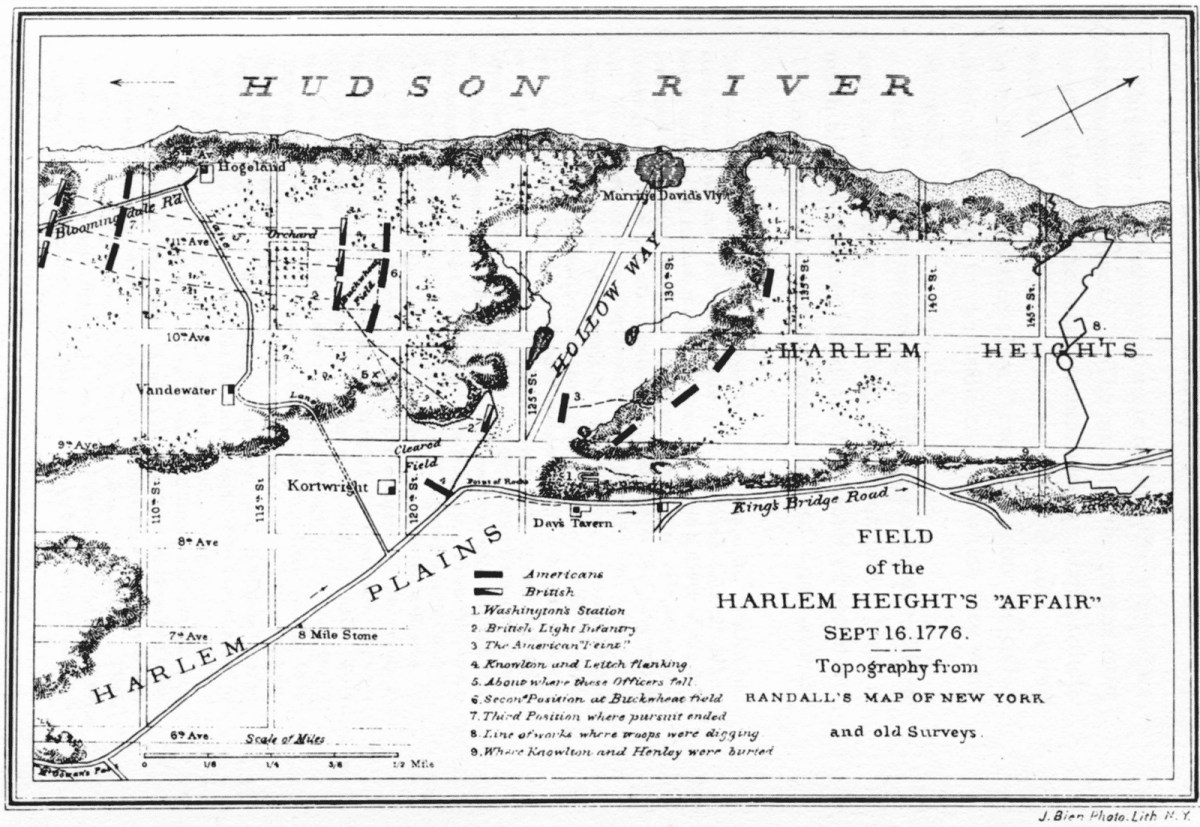
On the morning of the 16th, Rangers under Lieutenant Colonel Thomas Knowlton discovered the British pickets about a mile below the American line. Knowlton’s men skirmished with the British Light Infantry’s Second and Third Battalions, along with the Forty-second Highlanders, the “Black Watch.” The Americans were outnumbered, with about 120 men against about 400, and Knowlton ordered a retreat.

harlemheightsmap

Word of the engagement reached Washington as the Rangers were retreating back to their lines at Harlem. Washington and much of the American leadership watched the front that morning as Knowlton’s men returned. A number of the pursuing British could be seen from the American camp, and according to Adjutant-General Joseph Reed, the British buglers sounded a foxhunt call as they chased the retreating Rangers, halting at the Bloomingdale Heights. “I never felt such a sensation before, it seemed to crown our disgrace,” Reed wrote of the bugles.

The boldness of the British chase had separated them from the main army, giving the Americans a chance at their first victory. General Washington began setting a trap to take the isolated troops prisoner. He would first attack their front, while a flanking party would quietly assemble to their rear and prevent their escape.

The maneuver was executed nearly as planned. However, instead of attacking from the rear, the flanking party fired on the British side, which left open a route of escape. The British, realizing they had been nearly surrounded, began to run back up the slope of Bloomingdale Heights. The Americans gave chase “with splendid spirit and animation.”[2]

General Howe could hear the firing from his headquarters and sent reinforcements as well as two field pieces to aid the British. With the enemy on the run, Washington sent out three of the Maryland Independent companies and parts of the Maryland Flying Camp, who had recently arrived in New York. The Americans drove the British down from the Bloomingdale Heights to a field of buckwheat, where the smaller British contingent met with their reinforcements and took a stand. However, the Americans pressed on and pushed them further back.  After fighting the British back towards their encampment, Washington, whose men were not prepared to engage all of the troops situated in the British camp, sent out the order to withdraw.

The prisoners the Americans took that day would say that “they expected our Men would have run away as they did the day before, but they were never more surprised than to see us advancing to attack them.”[3]

The Marylanders especially gained recognition for their participation in the battle of Harlem Heights. A letter from the camp to Annapolis recounted that “General Washington gave great applause to our Maryland troops, for their gallant behaviour.”[4] Lieutenant Tench Tilghman, a Marylander who was Washington’s aide-de-camp and Secretary, would write that the Maryland and Virginia troops “bear the Palm.”

The Continental Army had its first lesson in victory. The Americans cheered before leaving the battlefield to return to Harlem Heights. Lieutenant Tilghman wrote of the improved morale, “on the whole the enemy got completely defeated, which has given great spirits to our army, who are… in high spirits, wailing the attack of the enemy.”[5]

The experience galvanized the revolutionary troops, who had suffered relentless losses over the preceding weeks, and would have to bear more defeats in the coming months.

Posted in battles, Maryland 400 | Tagged , , , , , , , | 3 Comments

“The Unhappy Situation”

It rained constantly for two days after the Battle of Long Island. The defeated Americans did not have enough tents or clothes, and the soggy troops could only wait for the storm to end. The Continental army’s ranks were depleted by disease and desertion; the Revolutionary struggle was at a discouraging juncture. However, the exhausted and ill-equipped troops had no time to recover from the loss at Long Island. After the Battle of Brooklyn, the British had a stronger position in New York than ever before. Continue reading

Posted in Maryland 400 | Tagged , , , , , , , | 4 Comments

The Rain and the Retreat

The morning of August 28, 1776 dawned cold, gray, and rainy. The demoralized American troops were trapped in their Brooklyn entrenchments, an area about three miles around. They were fenced in by the British army to their front and the East River to their back. The two armies were separated by no more than a mile of open ground, and they both kept up a constant peppering of bullets and cannon throughout the day. Continue reading

Posted in Maryland 400 | Tagged , , , , , | 1 Comment

Becoming the Maryland 400

By the afternoon of August 27, 1776, the Battle of Long Island had rapidly become a life or death struggle for the American army. After distracting the American forces with an auxiliary diversion that morning, the British sprung their trap. The night before the battle, Generals Howe and Clinton had led 10,000 troops to the rear of the Americans in a flanking maneuver. After the Americans had fought off the British diversion to their front, the 10,000 British descended upon the Continental troops from the north. According to one American soldier, the Americans were entirely unaware of the presence of the large force to their rear, until “the main body of their army, by a route we never dreamed of, had entirely surrounded us, and drove within the lines, or scattered in the woods, all our men, except the Delaware and Maryland battalions, who were standing at bay with double their number.” [1]
Continue reading

Posted in Maryland 400 | Tagged , , , , | 2 Comments

The British Diversion

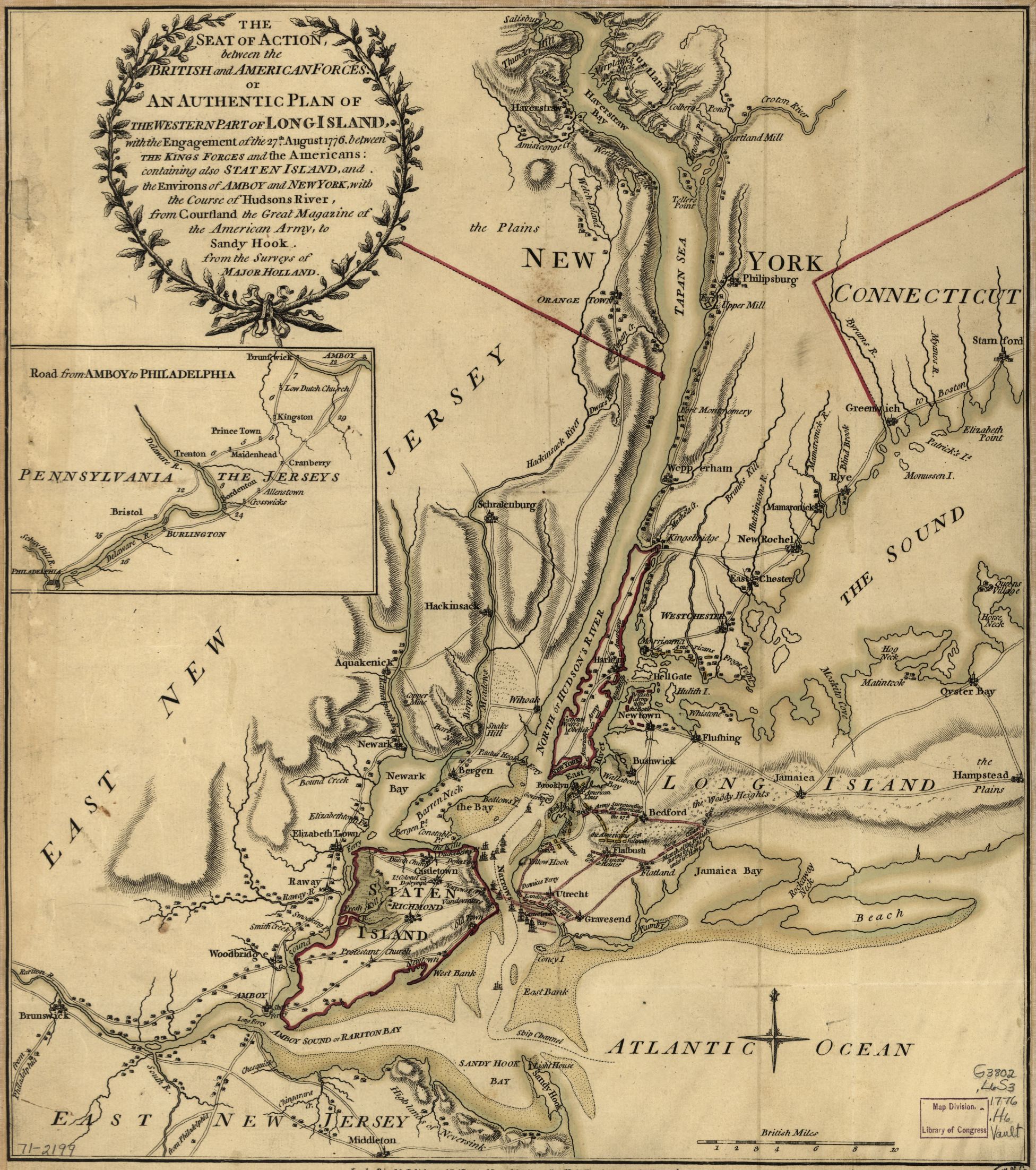
Samuel Holland 1776

This map shows the British and American troop movements on August 27, 1776. (Image credit: Library of Congress) For a different view of the battlefield, click here.

The Marylanders were called to battle before sunrise on August 27, 1776. Lord Stirling, the temporary commander of the Maryland troops, was awoken at around three o’clock in the morning and given the news that the British had begun their advance. [1] During the night, the British had surprised the American guard posted near the Red Lion Inn, and in the confusion, a number of Americans had been taken captive. General Israel Putnam ordered Stirling to take the two regiments “nearest at hand” and engage the British on the road near the Red Lion Inn. Continue reading

Posted in Maryland 400 | Tagged , , , | 2 Comments