A Fine Fox Chase: The Battle of Princeton

At the beginning of 1777 the Americans were in an unfamiliar position; they were on the offensive. In the week after capturing Trenton they had successfully parried the attacks of General Cornwallis, but a more serious engagement was inevitable before the two forces made camp for the winter. The events of January, 1777 could sustain or destroy the momentum the Americans had won at Trenton.

The morning of January 3, 1777 was bright and frigid, “with a hoar frost which bespangled every object.”[1] The remnants of Smallwood’s regiment had been Continue reading

Posted in battles, Maryland 400 | Tagged , , , , , , , , , , , | 1 Comment

The Crossing and the Capture

“For heaven’s sake, keep this to yourself,” George Washington wrote to Colonel Joseph Reed, laying out his plan to capture Trenton. “Christmas day at night, one hour before day, is the time fixed upon for our attempt on Trenton.”[1] The first year of the Revolution would soon come to an end, and the future of the struggle depended on the army’s success at Trenton. The Continental Army was forced to act—the British seemed primed to capture Philadelphia, and they were already in possession of New York, New Jersey, and Rhode Island. A victory before the end of the year would also help secure the reenlistments the army so desperately needed, as well as reviving morale in the general population, who had begun to lose confidence in the Revolutionary cause. However, every engagement carried risk; the crossing of the Delaware would be a delicate operation, and defeat would be catastrophic. Continue reading

Posted in battles, Maryland 400 | Tagged , , , , , , , , | 3 Comments

The Road to Trenton

December was a desperate month for the Revolutionary cause, which badly needed a victory to turn the tide of losses. Expiring enlistments were steadily chipping away at the size of the Continental Army, and the British established a winter camp on Philadelphia’s doorstep. If Philadelphia fell to the enemy the blow to morale would be crippling; it would be “severely felt by the common cause, and… wound the heart of every virtuous American.”[1] Defeat had become the standard for the Continental Army, but logistically and psychologically, another loss would be unbearable. Washington needed to marshal all of the strength the Revolution had left to defend Pennsylvania and make a stand along the Delaware river.

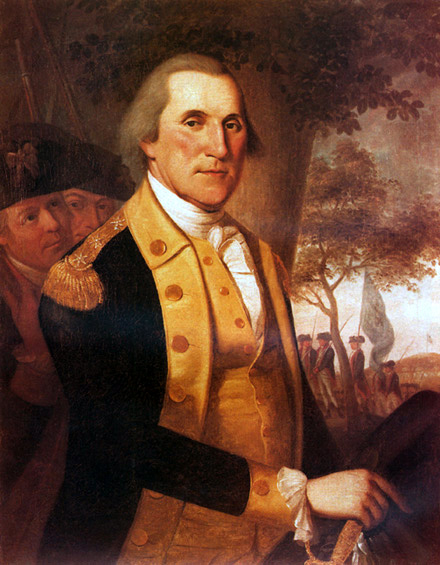
The brothers can be seen standing behind Washington’s right shoulder. James Peale is in front, Charles Willson Peale is behind him.
James Peale after Charles Willson Peale, 1787-1790. Independence National Historical Park Collection in Philadelphia.

Continue reading

Posted in battles, Maryland 400 | Tagged , , , , , , , , , , , | Comments Off on The Road to Trenton

“If I Fall on the Field of Battle”

Captain Daniel Bowie wrote his last will and testament on the eve of the Battle of Brooklyn. The next day he was wounded in battle and captured by the British. While imprisoned he would succumb to his wounds and become another casualty of the Revolution at the age of twenty-two. On August 26, 1776, that possibility could not have been far from his mind as he considered where he wanted to be buried–near his plantation’s garden walk and his father’s tomb– and how he would divide his possessions among his brothers and friends. Continue reading

Posted in Biographies, Maryland 400, wills | Tagged , , , , , , , , | 1 Comment

The Whig Club: Judge and Jury in Baltimore

It was a cold morning when Melchior Keener got word to leave Baltimore or suffer the vengeance of the Whig Club. At nine o’clock on December 5, 1776, James Cox, a popular local tailor, delivered the message that Keener had three days to settle his business and flee the city. The Whig Club had branded him a traitor to the revolutionary cause and an enemy of the country.

MARYLAND STATE PAPERS (Revolutionary Papers) Order to leave town. Dec. 5, 1776. MdHR 19970-13-10 [MSA S997-13-20 01/07/03/013]
Continue reading
Posted in Maryland 400 | Tagged , , , , , , , , , , | 1 Comment

Feeding an Army

The struggles of the Revolution can seem remote to generations living over two centuries later. However, the enjoyment of food and the challenges of feeding an army are both relatable themes to modern Americans as Thanksgiving approaches. Continue reading

Posted in Maryland 400 | Tagged , , , , , , , , , | 1 Comment

Soldiering On

In late November of 1776, the Continental Army was facing dismantlement by a surer force than the British military. The Americans’ enlistments were expiring. On December 10, a large chunk of the Continental Army, including many of the most experienced soldiers, would be free to return home. These included the men of the First Maryland Regiment who had joined at the beginning of the year. Furthermore, on January 1, nearly all of the remaining soldiers’ enlistments would expire. Continue reading

Posted in Maryland 400 | Tagged , , , , , , , , , , | 3 Comments

“A Cursed Affair”: The Loss of Fort Washington

“But alas! we must no longer think of holds and fortresses on the North River. There are, I hear, various opinions respecting the taking [of] fort Washington, some think that it was too easily surrendered, others say our men behaved well and that it could not possibly be help’d.” [1]

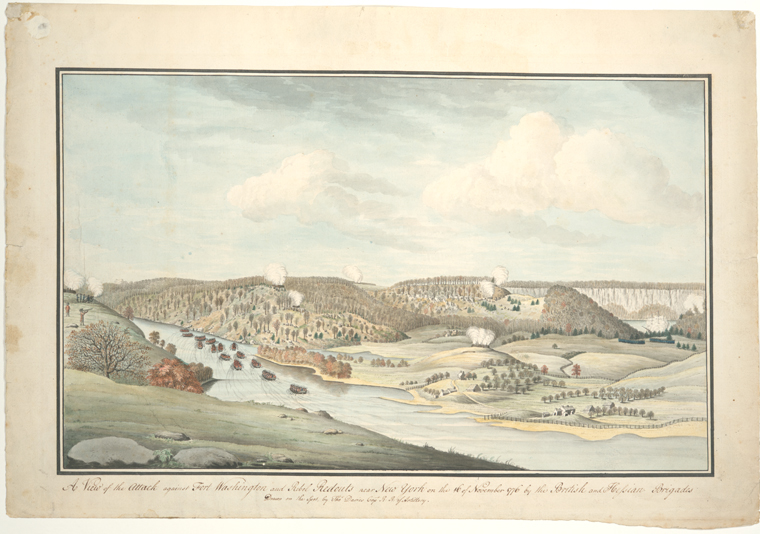
A View of the Attack against Ft. Washington, and Rebel Redoubts, near New York on the 16th of November, 1776, a drawing by Captain Thomas Davies, Royal Artillery. I.N. Phelps Stokes Collection, The New York Public Library, Astor, Lenox and Tilden Foundations. This image depicts British and German troops approaching the fort by the Harlem River.

A View of the Attack against Ft. Washington, and Rebel Redoubts, near New York on the 16th of November, 1776, a drawing by Captain Thomas Davies, Royal Artillery. I.N. Phelps Stokes Collection, The New York Public Library, Astor, Lenox and Tilden Foundations. This image depicts British and German troops approaching the fort by the Harlem River.

The November 16, 1776 capture of Fort Washington by the British was a particularly powerful blow against the Revolutionary cause. George Washington later wrote to his brother, John Augustine Washington, that Continue reading

Posted in battles, Maryland 400 | Tagged , , , , , , , | 1 Comment

An Interactive View of the Maryland 400

chartcapture

Click on this image to access our infographic!

In honor of Veteran’s Day next Monday, we are doing this blog entry a little differently to give you a closer look at what we know about the First Maryland Regiment. Click on the image above to see the latest findings of the Maryland 400 project. These interactive charts illustrate how close we are to putting soldiers’ names to the numbers from the Battle of Brooklyn in 1776. Continue reading

Posted in Maryland 400 | Tagged , , , , , , | 1 Comment

The Battle of White Plains

On October 28, 1776, the Continental Army had marched north of Manhattan, withdrawing  to the hills of the village of White Plains. Since the Battle of Brooklyn, General Howe had been pursuing the Continental Army in an attempt to encircle and destroy it. Although the Americans were not winning, their losses were actually helping the army steadily improve. The Battle of White Plains, which occurred on October 28, 1776, demonstrated the progress that the Continental Army had made since the Battle of Brooklyn in August. Continue reading

Posted in battles, Maryland 400 | Tagged , , , , , , , , | 1 Comment