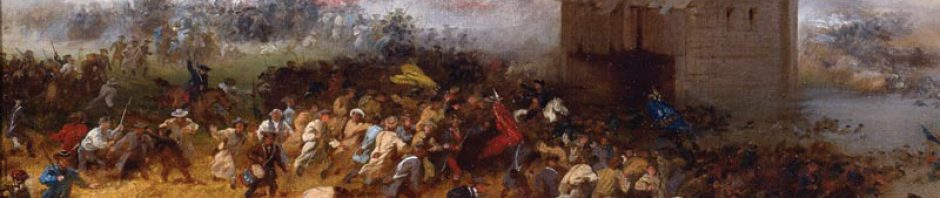
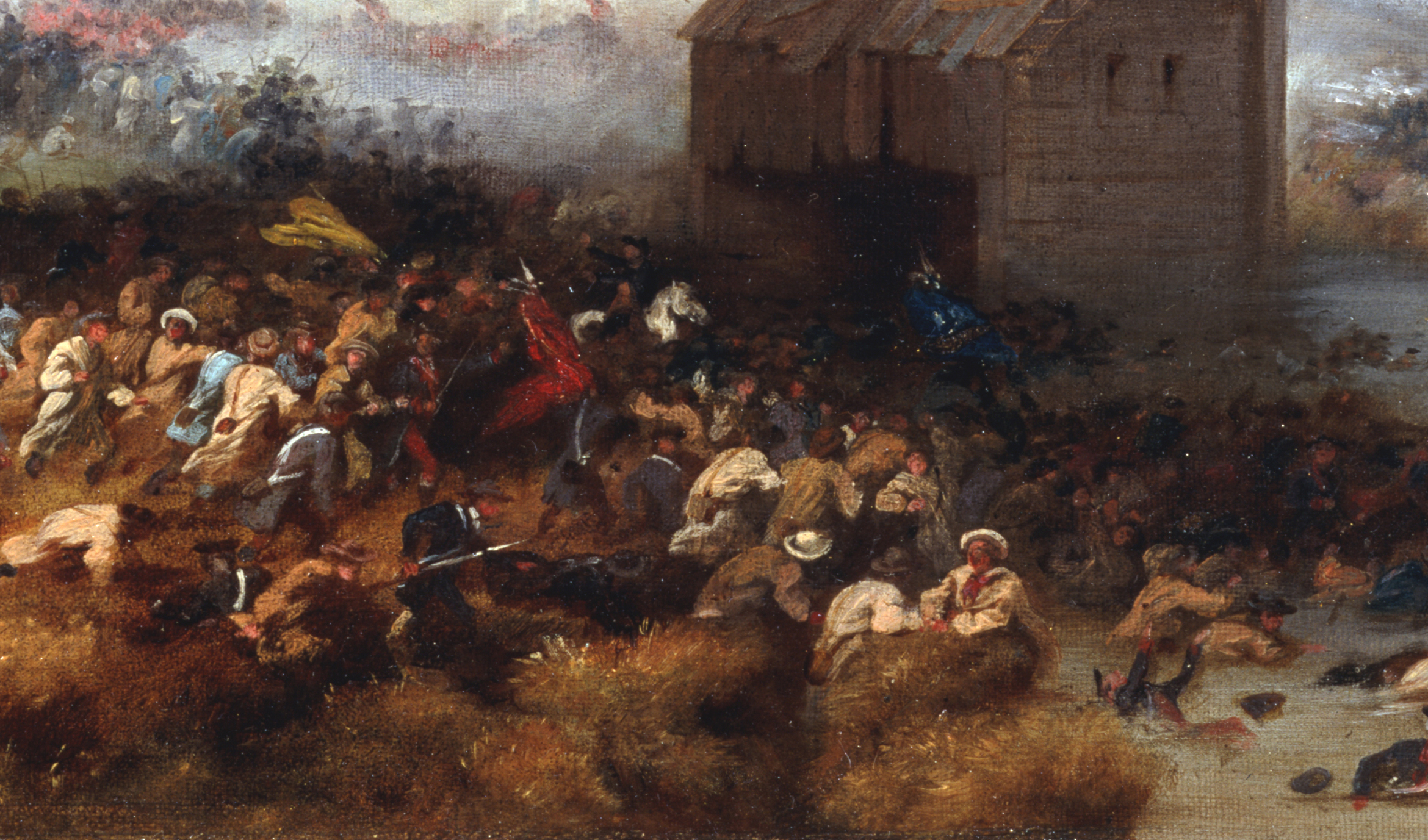
Alonzo Chapel, The Battle of Long Island (1858), Center for Brooklyn History, Brooklyn Public Library
Francis Osborn was a private in the Second Company when he fought at the Battle of Brooklyn in August 1776. Although his company lost only three men at the battle, Osborn’s experiences that day left their mark on him. When he was called for militia duty a few years later, he was exempted “appearing to be in no sort fit for the Service, nor likely to be so.”
What wounds, mental or physical, Osborn carried aren’t fully known. But more than forty years after the battle he still recalled seeing his captain, Patrick Sim, “knocked down by the body of Thomas Connor, whos head was shot off by a cannon shot.”
Osborn was mistaken about the man he saw killed: Thomas Connor (or O’Connor) survived the battle. However, Osborn undoubtedly witnessed terrible scenes. In fact, another Marylander at Brooklyn described how “the balls and shells flew very fast, now and then taking off a head.”
Some veterans of the Revolutionary War definitely suffered from what today be called Post-Traumatic Stress Disorder. At the time, there was little understanding of emotional trauma or mental illness, and it is very difficult to identify Revolutionary veterans with PTSD. There are some hints, however, such as a soldier from Virginia was unable to be around loud noise after being in combat, but could serve as a scout in the woods without difficulty. The wording of Osborn’s militia exemption could imply that he, too, was affected by PTSD.
Francis Osborn lived out the rest of his life in Prince George’s County, where he farmed on 200 acres, which made him a small-time land owner. He and his wife, Charity Pope, had nine children together. Francis died in 1824.
You can find out more about Maryland’s Revolutionary War soldiers and emotional trauma, in addition to the full story of Francis Osborn’s life, in Finding the Maryland 400. You can buy your copy here: https://msa.maryland.gov/maryland400.


Awesome read. Love these real-life stories of the founders of our country.
LikeLike