“Maryland Troops Bear the Palm”

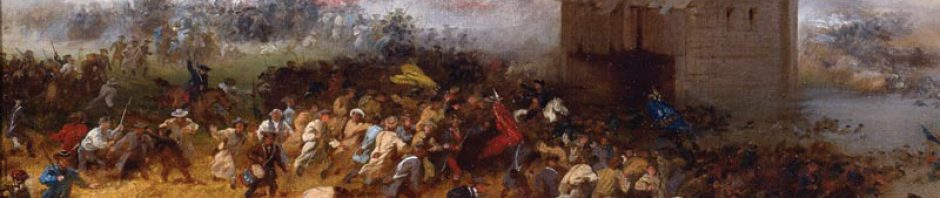
As of September 16, 1776, the revolutionary struggle had only resulted in defeat for the Americans. The week before in Boston, September 12 was declared a “day of prayer… on account of the critical state of our military operations.”[1] British ships cruised the East River, General Howe had landed troops in Manhattan the day before, and it was becoming clear that the weakened Continental Army would not hold New York for much longer. Nearly the whole American force had withdrawn to Harlem Heights. However, a victory was finally on the horizon.

After the British landed in the south at Kip’s Bay on the 15th, Washington sent Smallwood’s Marylanders to cover the American retreat from New York City to the line at Harlem. The Maryland regiment remained under arms until nightfall, when they also returned to the American lines.

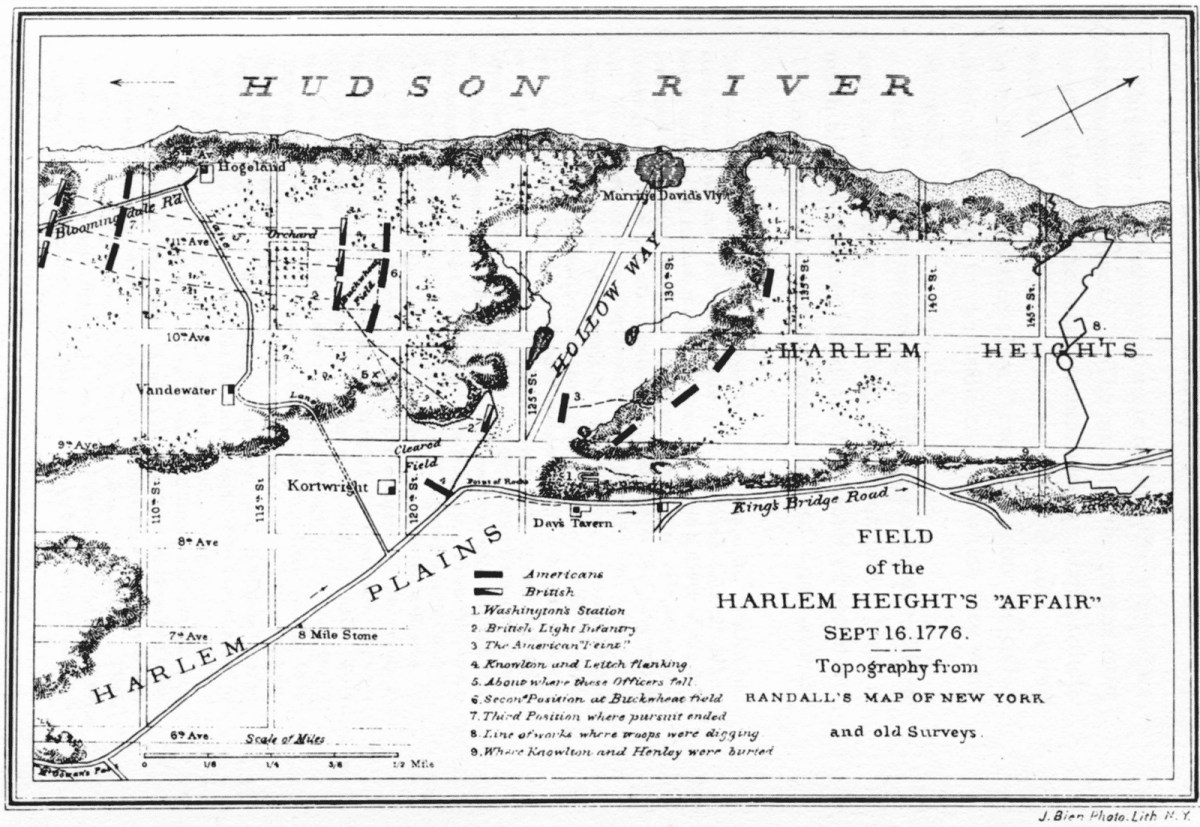
On the morning of the 16th, Rangers under Lieutenant Colonel Thomas Knowlton discovered the British pickets about a mile below the American line. Knowlton’s men skirmished with the British Light Infantry’s Second and Third Battalions, along with the Forty-second Highlanders, the “Black Watch.” The Americans were outnumbered, with about 120 men against about 400, and Knowlton ordered a retreat.
harlemheightsmap

Word of the engagement reached Washington as the Rangers were retreating back to their lines at Harlem. Washington and much of the American leadership watched the front that morning as Knowlton’s men returned. A number of the pursuing British could be seen from the American camp, and according to Adjutant-General Joseph Reed, the British buglers sounded a foxhunt call as they chased the retreating Rangers, halting at the Bloomingdale Heights. “I never felt such a sensation before, it seemed to crown our disgrace,” Reed wrote of the bugles.

The boldness of the British chase had separated them from the main army, giving the Americans a chance at their first victory. General Washington began setting a trap to take the isolated troops prisoner. He would first attack their front, while a flanking party would quietly assemble to their rear and prevent their escape.

The maneuver was executed nearly as planned. However, instead of attacking from the rear, the flanking party fired on the British side, which left open a route of escape. The British, realizing they had been nearly surrounded, began to run back up the slope of Bloomingdale Heights. The Americans gave chase “with splendid spirit and animation.”[2]

General Howe could hear the firing from his headquarters and sent reinforcements as well as two field pieces to aid the British. With the enemy on the run, Washington sent out three of the Maryland Independent companies and parts of the Maryland Flying Camp, who had recently arrived in New York. The Americans drove the British down from the Bloomingdale Heights to a field of buckwheat, where the smaller British contingent met with their reinforcements and took a stand. However, the Americans pressed on and pushed them further back.  After fighting the British back towards their encampment, Washington, whose men were not prepared to engage all of the troops situated in the British camp, sent out the order to withdraw.

The prisoners the Americans took that day would say that “they expected our Men would have run away as they did the day before, but they were never more surprised than to see us advancing to attack them.”[3]

The Marylanders especially gained recognition for their participation in the battle of Harlem Heights. A letter from the camp to Annapolis recounted that “General Washington gave great applause to our Maryland troops, for their gallant behaviour.”[4] Lieutenant Tench Tilghman, a Marylander who was Washington’s aide-de-camp and Secretary, would write that the Maryland and Virginia troops “bear the Palm.”

The Continental Army had its first lesson in victory. The Americans cheered before leaving the battlefield to return to Harlem Heights. Lieutenant Tilghman wrote of the improved morale, “on the whole the enemy got completely defeated, which has given great spirits to our army, who are… in high spirits, wailing the attack of the enemy.”[5]

The experience galvanized the revolutionary troops, who had suffered relentless losses over the preceding weeks, and would have to bear more defeats in the coming months.

Posted in battles, Maryland 400 | Tagged , , , , , , , | 3 Comments

“The Unhappy Situation”

It rained constantly for two days after the Battle of Long Island. The defeated Americans did not have enough tents or clothes, and the soggy troops could only wait for the storm to end. The Continental army’s ranks were depleted by disease and desertion; the Revolutionary struggle was at a discouraging juncture. However, the exhausted and ill-equipped troops had no time to recover from the loss at Long Island. After the Battle of Brooklyn, the British had a stronger position in New York than ever before. Continue reading

Posted in Maryland 400 | Tagged , , , , , , , | 4 Comments

The Rain and the Retreat

The morning of August 28, 1776 dawned cold, gray, and rainy. The demoralized American troops were trapped in their Brooklyn entrenchments, an area about three miles around. They were fenced in by the British army to their front and the East River to their back. The two armies were separated by no more than a mile of open ground, and they both kept up a constant peppering of bullets and cannon throughout the day. Continue reading

Posted in Maryland 400 | Tagged , , , , , | 1 Comment

Becoming the Maryland 400

By the afternoon of August 27, 1776, the Battle of Long Island had rapidly become a life or death struggle for the American army. After distracting the American forces with an auxiliary diversion that morning, the British sprung their trap. The night before the battle, Generals Howe and Clinton had led 10,000 troops to the rear of the Americans in a flanking maneuver. After the Americans had fought off the British diversion to their front, the 10,000 British descended upon the Continental troops from the north. According to one American soldier, the Americans were entirely unaware of the presence of the large force to their rear, until “the main body of their army, by a route we never dreamed of, had entirely surrounded us, and drove within the lines, or scattered in the woods, all our men, except the Delaware and Maryland battalions, who were standing at bay with double their number.” [1]
Continue reading

Posted in Maryland 400 | Tagged , , , , | 2 Comments

The British Diversion

Samuel Holland 1776

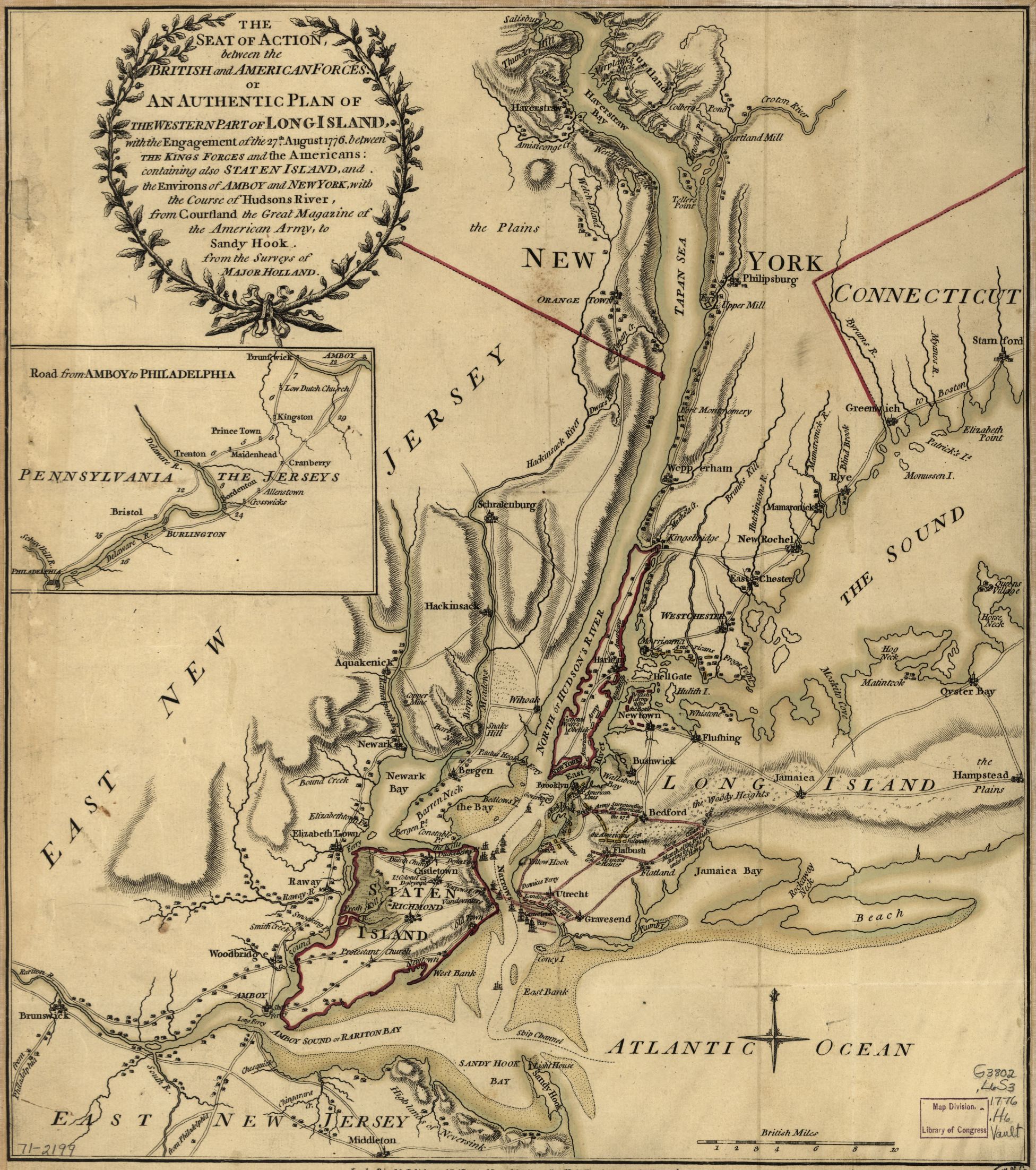
This map shows the British and American troop movements on August 27, 1776. (Image credit: Library of Congress) For a different view of the battlefield, click here.

The Marylanders were called to battle before sunrise on August 27, 1776. Lord Stirling, the temporary commander of the Maryland troops, was awoken at around three o’clock in the morning and given the news that the British had begun their advance. [1] During the night, the British had surprised the American guard posted near the Red Lion Inn, and in the confusion, a number of Americans had been taken captive. General Israel Putnam ordered Stirling to take the two regiments “nearest at hand” and engage the British on the road near the Red Lion Inn. Continue reading

Posted in Maryland 400 | Tagged , , , | 2 Comments

The Marylanders Arrive

On August 26, 1776, the Marylanders arrived at Long Island on the eve of battle. Once it became clear that a major engagement was imminent, Washington sent the regiment to reinforce the American defensive line. The men who would become known as the Maryland 400 were posted on the Heights of Guana, a wooded, ten-mile ridge near the British encampment at the town of Flatbush. They joined with the force already there, which had fought a number of skirmishes with the British, and the small engagements served to boost the confidence of the inexperienced Continental soldiers. An intelligence report from New York mentioned the recent encounters with the British, “We have had only four men wounded since the enemy landed; but we are certain many of them [the British] fell.” [1] Continue reading

Posted in Maryland 400 | Tagged , , , , , , | 3 Comments

“They must be well watched”

After the British landed on Long Island they advanced to within three miles of the American lines, and then they stopped. On August 23rd, 1776, the tension grew in New York as the American leadership tried to determine the enemy’s next move. The standoff that began on August 22nd reinforced the Americans’ belief that the British were using Long Island as a diversion, and the main attack would come to Manhattan.  General William Heath of Massachusetts captured the Americans’ uneasiness on the 23rd when he wrote to Washington, “I hope soon to hear good news from Long Island. I have never been afraid of the force of the enemy: I am more so of their arts. They must be well watched.”[1] Continue reading

Posted in Maryland 400 | Tagged , , , , , , | 1 Comment

The British Come Ashore

On August 22nd, 1776, the British began setting the stage for battle by landing troops on Long Island. The Continental Army had been present in varying numbers on Long Island for nearly four months, since General Nathanael Greene was ordered to encamp there on May 1st, and with the arrival of additional Hessian troops to aid the British on August 25th, only five days remained until the forces would finally clash at the Battle of Long Island on August 27th.[1] Continue reading

Posted in Maryland 400 | Tagged , , , , , , , , | 1 Comment

Emily’s Introduction

Hello everyone,

My name is Emily Huebner, and I have the privilege of inheriting the Maryland 400 project, which was started by the talented research and analysis of Jeff and Daniel. I recently graduated from Goucher College in May of 2013, majoring in History and Spanish with a minor in Latin American studies. The American Revolution is one of my favorite historic subjects, and I am excited to have the opportunity to work on the Maryland 400 project. Continue reading

Posted in Maryland 400 | Tagged , | Comments Off on Emily’s Introduction

Thank you!

We recently received our 2,500th visit to the blog, a number that we’re quite proud of! We are very grateful to all of you who have visited and taken the time to read and comment. Thank you so much! The Battle of Long Island took place at the end of August, and we’re preparing to mark the anniversary of the battle, as well as the action in the days before and after, so stay tuned. Continue reading

Posted in Maryland 400 | Tagged , | 1 Comment