Project sponsored by the Maryland Society of the Sons of the American Revolution

Recent posts: Finding the Maryland 400
Help Support the Maryland 400!
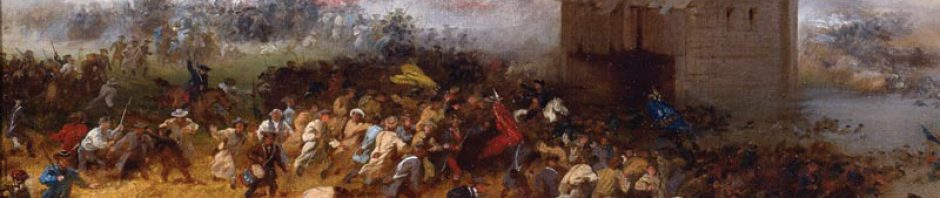
In August 1776, a group of soldiers—the Maryland 400—helped hold back the British Army at the Battle of Brooklyn, allowing the rest of the Americans to escape the field. The Marylanders lost a quarter of their men that day, but their stand saved the Continental Army, allowing it to live and fight another day. For […]
Revolutionary Book Review: George the Drummer Boy

The first book I ever read about the American Revolution was a children’s book called George the Drummer Boy, by Nathaniel Benchley, with illustrations by Don Bolognese. It tells the story of a drummer in the British Army who is stationed in Boston in 1775. His unit is chosen to march out of Boston to […]
A New Podcast Tells the Story of the Maryland Line
We are excited to share that a new podcast about the Revolutionary War, and Maryland’s soldiers, has been launched by Mission History. The series tells the story of the events that brought two armies, including nearly 2,000 soldiers from Maryland, to Camden, South Carolina in August 1781. The battle fought at Camden was one of […]
A Beating in Baltimore: Communal Violence during the Revolution
Today’s post comes from Marshall Cooperman of St. John’s College in Annapolis, who was part of the Maryland State Archives’ intern class of 2023. Marshall’s project team worked on cataloging a large collection of Revolutionary-era correspondence, and he came across the letters that tell this story while doing that work America in 1776 was a […]
Tag Archives: Maryland
Battle of Brooklyn Roll of Honor
On August 27, 1776, after a week of anticipation, and hours of marching, the Continental Army fought the British at the Battle of Brooklyn, the first large-scale battle of the Revolutionary War. All told, the Americans lost about 300 killed, … Continue reading
Men who “could stand cutting”: The Old Maryland Line
The famed Maryland 400 were not the only Revolutionary War soldiers hailed as heroes. Indeed, throughout the war, the Maryland Line (as the state’s contribution to the Continental Army was called) developed a reputation for skill and bravery. They were … Continue reading
Maryland’s African American Troops
Earlier, we introduced the topic of black Revolutionary War soldiers, but left unanswered the question of whether any fought as part of the Maryland 400. While a number of African Americans fought as part of the Maryland Line later in … Continue reading
African Americans in the Revolutionary War
In October, Congress gave preliminary approval to a monument on the National Mall to African American Revolutionary War soldiers. While much work remains to be done before a monument is actually constructed, this was an important step for the project, … Continue reading
Demographics in the First Maryland Regiment
A former member of the Fifth Company who fought at the Battle of Brooklyn, John Burgess was described as a slender, 42-year-old man, with light brown hair, a “swarthy” complexion, and a height of five feet eleven inches, who was … Continue reading
The Midnight Ride of Paul Revere
Listen my children and you shall hear Of the midnight ride of Paul Revere, On the Eighteenth of April, in Seventy-five; Hardly a man is now alive Who remembers that famous day and year. So wrote Henry Wadsworth Longfellow in … Continue reading
Introducing the Interactive Map
Geography physically connects us to the past in a way that can dust the cobwebs off of history and make it more accessible to the modern world. This interactive map shows where Smallwood’s men came from and the places where … Continue reading
The Prisoner and the Privateer
Two new entries have been added to the biography page! William Sterrett and Phillip Hawkins were Baltimoreans who fought in different companies of Smallwood’s Battalion at the Battle of Brooklyn. Both men were also survivors of the British prison ships … Continue reading
The Road to Trenton
December was a desperate month for the Revolutionary cause, which badly needed a victory to turn the tide of losses. Expiring enlistments were steadily chipping away at the size of the Continental Army, and the British established a winter camp … Continue reading
“If I Fall on the Field of Battle”
Captain Daniel Bowie wrote his last will and testament on the eve of the Battle of Brooklyn. The next day he was wounded in battle and captured by the British. While imprisoned he would succumb to his wounds and become … Continue reading

 Finding the Maryland 400