Project sponsored by the Maryland Society of the Sons of the American Revolution

Recent posts: Finding the Maryland 400
Help Support the Maryland 400!
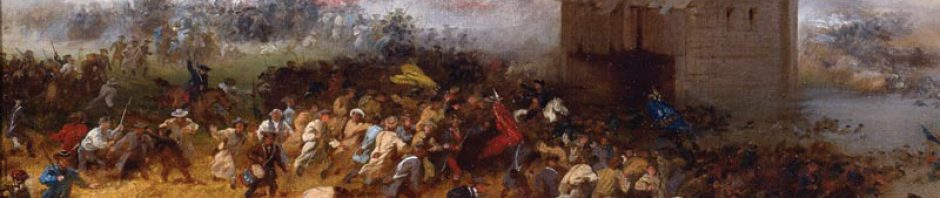
In August 1776, a group of soldiers—the Maryland 400—helped hold back the British Army at the Battle of Brooklyn, allowing the rest of the Americans to escape the field. The Marylanders lost a quarter of their men that day, but their stand saved the Continental Army, allowing it to live and fight another day. For […]
Revolutionary Book Review: George the Drummer Boy

The first book I ever read about the American Revolution was a children’s book called George the Drummer Boy, by Nathaniel Benchley, with illustrations by Don Bolognese. It tells the story of a drummer in the British Army who is stationed in Boston in 1775. His unit is chosen to march out of Boston to […]
A New Podcast Tells the Story of the Maryland Line
We are excited to share that a new podcast about the Revolutionary War, and Maryland’s soldiers, has been launched by Mission History. The series tells the story of the events that brought two armies, including nearly 2,000 soldiers from Maryland, to Camden, South Carolina in August 1781. The battle fought at Camden was one of […]
A Beating in Baltimore: Communal Violence during the Revolution
Today’s post comes from Marshall Cooperman of St. John’s College in Annapolis, who was part of the Maryland State Archives’ intern class of 2023. Marshall’s project team worked on cataloging a large collection of Revolutionary-era correspondence, and he came across the letters that tell this story while doing that work America in 1776 was a […]
Tag Archives: history
Col. Gaither: Seven years on Georgia’s frontier
A new biography expands on previous writing on this blog about Henry Chew Gaither, a Revolutionary War captain of the First and Fourth Maryland Regiments. On the eve of the Battle of Brooklyn, he served as a witness for Daniel … Continue reading
Introducing the Interactive Map
Geography physically connects us to the past in a way that can dust the cobwebs off of history and make it more accessible to the modern world. This interactive map shows where Smallwood’s men came from and the places where … Continue reading
The Prisoner and the Privateer
Two new entries have been added to the biography page! William Sterrett and Phillip Hawkins were Baltimoreans who fought in different companies of Smallwood’s Battalion at the Battle of Brooklyn. Both men were also survivors of the British prison ships … Continue reading
Winter at Morristown
After the battles of Trenton and Princeton, the American troops made winter headquarters at Morristown, New Jersey on January 6.[1] Traditionally, wars were not fought during the wintertime, but the American Revolution was not a conventional European war. The winter … Continue reading
A Fine Fox Chase: The Battle of Princeton
At the beginning of 1777 the Americans were in an unfamiliar position; they were on the offensive. In the week after capturing Trenton they had successfully parried the attacks of General Cornwallis, but a more serious engagement was inevitable before … Continue reading
The Crossing and the Capture
“For heaven’s sake, keep this to yourself,” George Washington wrote to Colonel Joseph Reed, laying out his plan to capture Trenton. “Christmas day at night, one hour before day, is the time fixed upon for our attempt on Trenton.”[1] The first … Continue reading
The Road to Trenton
December was a desperate month for the Revolutionary cause, which badly needed a victory to turn the tide of losses. Expiring enlistments were steadily chipping away at the size of the Continental Army, and the British established a winter camp … Continue reading
“If I Fall on the Field of Battle”
Captain Daniel Bowie wrote his last will and testament on the eve of the Battle of Brooklyn. The next day he was wounded in battle and captured by the British. While imprisoned he would succumb to his wounds and become … Continue reading
The Whig Club: Judge and Jury in Baltimore
It was a cold morning when Melchior Keener got word to leave Baltimore or suffer the vengeance of the Whig Club. At nine o’clock on December 5, 1776, James Cox, a popular local tailor, delivered the message that Keener had three … Continue reading

 Finding the Maryland 400