Washington’s Immortals Lecture in Baltimore

If you are in the area this week, head over to the Maryland Historical Society to see Patrick K. O’Donnell discuss his book Washington’s Immortals. Those immortals were, of course, the soldiers from Maryland.

The Maryland Line was built around a core of veterans, experienced men who had survived the Battle of Brooklyn and the rest of the 1776 campaign. The success of the Marylanders in the last years of the Revolutionary War owed much to the dedicated service of the men who volunteered to fight in the war’s earliest days. They were among George Washington’s most trusted troops.

O’Donnell’s book is full of wonderful stories, many of them about men we have written about as part of this project, men like William and Samuel McMillan, who escaped from a British prison, along with William Sterrett and James Peale. (see also here for more on the Peale family).

For more information about the lecture, see this flyer.

Posted in Maryland 400 | Comments Off on Washington’s Immortals Lecture in Baltimore

An update on the update

We hope you’ve enjoyed some of the changes we’ve made over the last few weeks. One of the big changes we made was updating the biographies page.  Our goal is to make it easier to learn about Marylanders during the war by adding short descriptions next to some of our favorite biographies.  Please check them out here and let us know what you think in the comments below!


Another helpful addition we made was creating a “featured posts” page, where you can easily find some of our most popular and informative posts we’ve made.  If you click here, you’ll also see that at the top of the page we now feature as ‘Editor’s Choice’ post of the month.  For the month of March, we selected the Editor’s Choice block to a post celebrating Women’s History Month.

We hope you like these changes and just know that more are on the way!


Posted in Maryland 400 | Comments Off on An update on the update

Finding the Maryland 400 Job Opportunity

Would you like to come work for Finding the Maryland 400?

The Maryland State Archives is looking for a staff researcher to work on the project, researching and writing biographies of the soldiers of the Maryland 400, and updating the blog. This is a paid, full time position, with funding to last approximately six months, although there is the possibility of additional funding. This is an ideal position for a recent history graduate.

To apply, visit this link: https://www.jobaps.com/MD/sup/bulpreview.asp?R1=17&R2=005302&R3=0006. The application deadline is March 24.

This position is funded through the generous support of the Maryland Society of the Sons of the American Revolution.

Posted in Maryland 400 | Comments Off on Finding the Maryland 400 Job Opportunity

An Update is coming!

Please forgive our appearance over the next three months while our website undergoes some changes. Your patience will be greatly appreciated and I promise it will pay off.  The upgrade will seek to streamline the website so that we can better highlight and emphasize the most valuable pieces of information here.  We will also be adding different educational tools to the website for students and teachers. Continue reading

Posted in Maryland 400 | Comments Off on An Update is coming!

The Maryland 400’s Veterans

The mission of Finding the Maryland 400 is to pay tribute to Maryland’s Revolutionary War veterans. Today, however, we want to focus on the members of the First Maryland Regiment who were already veterans before the unit’s first battle in Brooklyn in August 1776.

Almost none of the soldiers of the Maryland 400 had any military experience. Indeed, that’s part of what make their heroism at the Battle of Brooklyn so remarkable: only four men had ever been in battle before, and none of them was even present during the fighting.

Lieutenant Colonel Francis Ware and Captain Barton Lucas had both fought in the French and Indian War, taking part in an unsuccessful British attempt to capture Fort Duquesne (now Pittsburgh, PA) in 1758, where Lucas was wounded. Neither Ware nor Lucas was on the field during the Battle of Brooklyn, however. Lucas was too sick to fight, as many Americans were. Ware, along with the Marylanders’ commander Colonel William Smallwood, was required by George Washington to take part in the court martial of Herman Zedwitz, a German officer in the Continental Army, accused of trying to sell American secrets to the British. Washington refused to allow Ware, Smallwood, and the other officers on the military jury travel with their units to Brooklyn to face the British. Continue reading

Posted in Maryland 400 | Tagged , , , , , , , , , , , | 1 Comment

A “little groggy”: the deputy sheriff of Baltimore and his “bowl of toddy”

Photographs of a hot toddy

Photograph of two hot toddy drinks

On December 21, 1776, Sergeant John Hardman of the Edward Veazey‘s Seventh Independent Company arrived at a public prison in Baltimore Town with captured British soldiers. [1] He was there escorting the British prisoners from Philadelphia. That night, Hardman ordered a “bowl of toddy” for the prisoners. Toddy, a popular drink originally adopted by the British, consisted of rum, hot water, and sugar.

Two other men, Daniel Curtis, the Baltimore County Sheriff, and John Ross, his deputy, asked for a “bowl of liquor.” [2] Ross, also a keeper of the town’s poor house, engaged in a friendly conversation with the prisoners, amongst whom Hardman was sitting. [3]

What happened next made people uneasy. Continue reading

Posted in Baltimore, Maryland 400, slaveowners | Tagged , , , , , , , , , , , , , , , , , , , , | Comments Off on A “little groggy”: the deputy sheriff of Baltimore and his “bowl of toddy”

Victory at Yorktown!

On October 19, 1781, British General Charles, Lord Conwallis surrendered his army of more than 8,000 men to George Washington at Yorktown, Virginia. Cornwallis’s action brought an end to a siege which had lasted nearly two weeks.  It was also the end of major combat in the American Revolution.

Although soldiers from Maryland fought at nearly all major battles of the war, often playing pivotal roles in combat, none took part in the Battle of Yorktown. The Third and Fourth Maryland Regiments were in the Yorktown area, but apparently took no part in the fighting.  The greatest contribution to the victory at Yorktown that the Marylanders made was in keeping a contingent of British reinforcements bottled up in South Carolina, unable to reach Cornwallis. It was probably just as well, since the Maryland Line had been reduced to a small fragment of its original strength. [1] Continue reading

Posted in Maryland 400 | Tagged , , , , , , | 4 Comments

Sickened Marylanders and the Philadelphia Bettering House

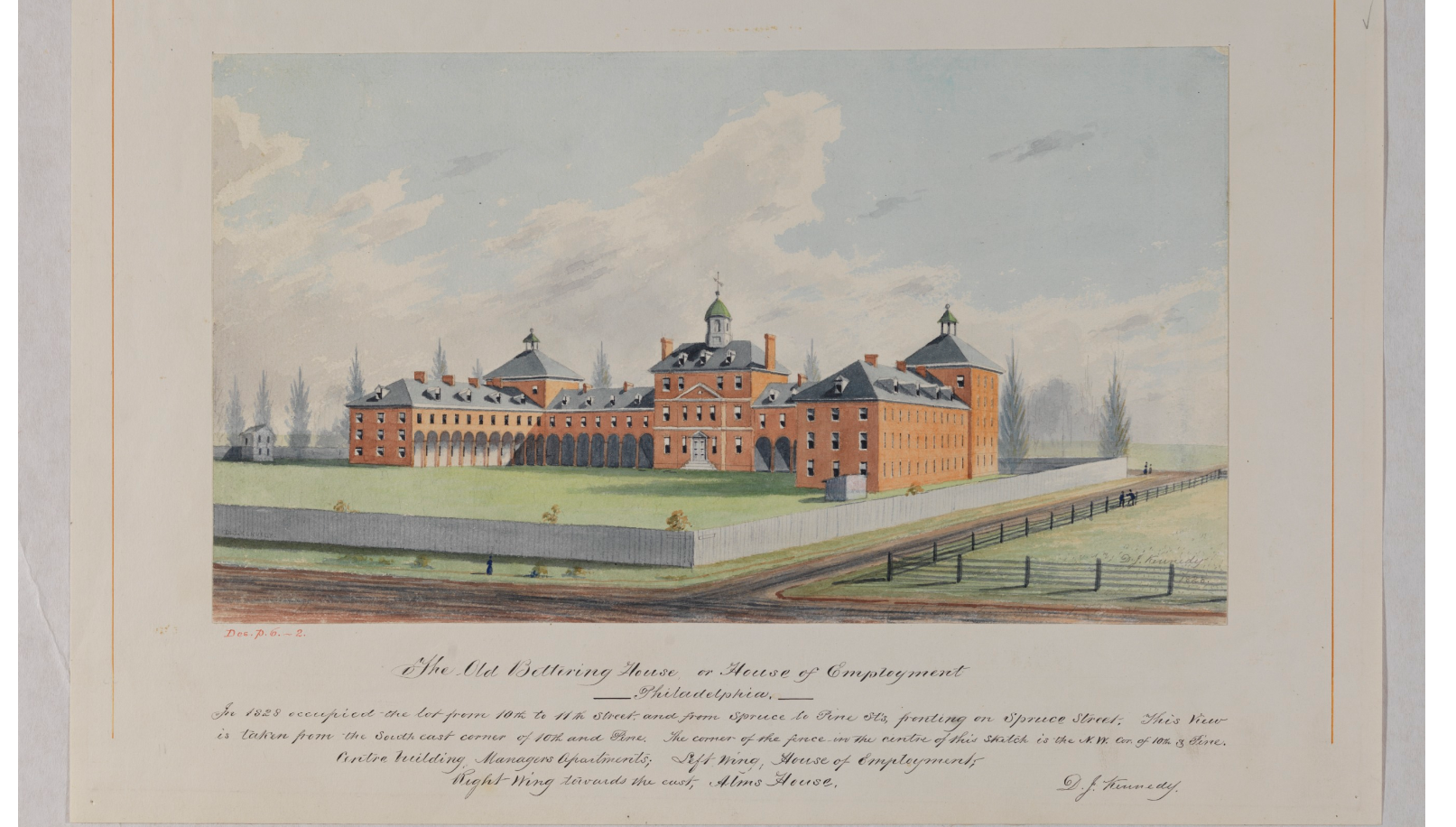
An illustration of the Philadelphia Bettering House in 1828, courtesy of the Historical Society of Pennsylvania.

An illustration of the Philadelphia Bettering House in 1828, courtesy of the Historical Society of Pennsylvania, which is likely what it looked like in 1776 and 1777 as well.

On April 13, 1777, John Adams described the spread of disease in Philadelphia and the fate of the sick soldiers in that city in a letter to his wife, Abigail Smith. In his letter, he mentioned a local institution, called the Philadelphia Bettering House. He told her that

“I have spent an Hour, this Morning, in the Congregation of the dead. I took a Walk into the Potters Field, a burying Ground between the new stone Prison, and the Hospital, and I never in my whole Life was affected with so much Melancholly. The Graves of the soldiers, who have been buryed, in this Ground, from the Hospital and bettering House, during the Course of the last Summer, Fall, and Winter, dead of the small Pox, and Camp Diseases, are enough to make the Heart of stone to melt away. The Sexton told me, that upwards of two Thousand soldiers had been buried there…To what Causes this Plague is to be attributed I dont know….Disease has destroyed Ten Men for Us, where the Sword of the Enemy has killed one.” [1]

Continue reading

Posted in Baltimore, Maryland 400 | Tagged , , , , , , , , , , , , , , , , , , | 5 Comments

“The misfortune which ensued”: The defeat at Germantown

Saverio Xavier della Gatta, an eighteenth-century Neopolitan painter, painted this scene of the Battle of Germantown in 1782, possibly for a British officer. Courtesy of the Museum of the American Revolution.

On the morning of October 4, 1777, Continental troops encountered British forces, led by Lord William Howe, encamped at Germantown, Pennsylvania, in Philadelphia’s outskirts. George Washington believed that he had surprise on his side. [1] He had ordered his multiple divisions to march twenty miles from their camp at Perkeomen, with some of the soldiers having neither food or blankets. [2] Washington thought that if the British were defeated he could retake the Continental capital of Philadelphia and reverse his disaster at Brandywine.

Among the men who marched with Washington were 210 Marylanders, including many veterans of the Maryland 400. [3] The seven Maryland regiments, commanded by General John Sullivan, were at the lead of the Continental attack. After marching most of the night, like the rest of the Continental Army, they arrived at Chestnut Hill, three miles from Mount Airy, and encountered a British picket. [4] Later, Sullivan’s division advanced and fought British light infantry in a 15-20 minute clash in an orchard. Continue reading

Posted in battles, Maryland 400 | Tagged , , , , , , , , , , , , | 6 Comments

“Flecking the hedges with red”: Palmer’s Ballad on the Maryland 400

palmer-photo-150x150

A photograph of John Williamson Palmer who wrote ‘The Maryland Battalion’

In the past, we have written about poems and songs relating to the Maryland 400. [1] They were celebrated years after and during the Revolutionary War, with newspapers often containing poems and songs. Such poems included one about William Sterrett in 1776 and a song by Tom Wisner titled “The Old Line.” Poems and ballads, which are narrative poems, not only appeared in newspapers but also in books. This post analyzes the 1901 ballad titled “The Maryland Battalion in the Battle of Long Island” and its author. [2] Continue reading

Posted in Maryland 400, poems | Tagged , , , , , , , , , , , , , , , | Comments Off on “Flecking the hedges with red”: Palmer’s Ballad on the Maryland 400