Feeding an Army

The struggles of the Revolution can seem remote to generations living over two centuries later. However, the enjoyment of food and the challenges of feeding an army are both relatable themes to modern Americans as Thanksgiving approaches. Continue reading

Posted in Maryland 400 | Tagged , , , , , , , , , | 1 Comment

Soldiering On

In late November of 1776, the Continental Army was facing dismantlement by a surer force than the British military. The Americans’ enlistments were expiring. On December 10, a large chunk of the Continental Army, including many of the most experienced soldiers, would be free to return home. These included the men of the First Maryland Regiment who had joined at the beginning of the year. Furthermore, on January 1, nearly all of the remaining soldiers’ enlistments would expire. Continue reading

Posted in Maryland 400 | Tagged , , , , , , , , , , | 3 Comments

“A Cursed Affair”: The Loss of Fort Washington

“But alas! we must no longer think of holds and fortresses on the North River. There are, I hear, various opinions respecting the taking [of] fort Washington, some think that it was too easily surrendered, others say our men behaved well and that it could not possibly be help’d.” [1]

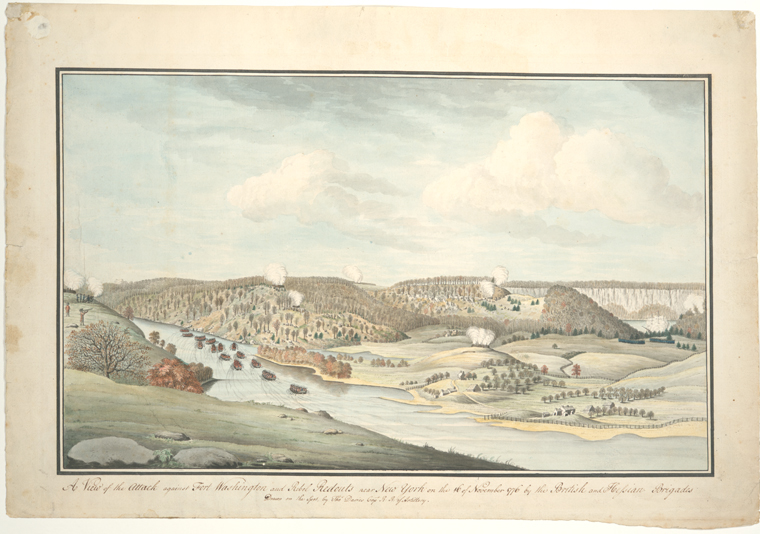
A View of the Attack against Ft. Washington, and Rebel Redoubts, near New York on the 16th of November, 1776, a drawing by Captain Thomas Davies, Royal Artillery. I.N. Phelps Stokes Collection, The New York Public Library, Astor, Lenox and Tilden Foundations. This image depicts British and German troops approaching the fort by the Harlem River.

A View of the Attack against Ft. Washington, and Rebel Redoubts, near New York on the 16th of November, 1776, a drawing by Captain Thomas Davies, Royal Artillery. I.N. Phelps Stokes Collection, The New York Public Library, Astor, Lenox and Tilden Foundations. This image depicts British and German troops approaching the fort by the Harlem River.

The November 16, 1776 capture of Fort Washington by the British was a particularly powerful blow against the Revolutionary cause. George Washington later wrote to his brother, John Augustine Washington, that Continue reading

Posted in battles, Maryland 400 | Tagged , , , , , , , | 1 Comment

An Interactive View of the Maryland 400

chartcapture

Click on this image to access our infographic!

In honor of Veteran’s Day next Monday, we are doing this blog entry a little differently to give you a closer look at what we know about the First Maryland Regiment. Click on the image above to see the latest findings of the Maryland 400 project. These interactive charts illustrate how close we are to putting soldiers’ names to the numbers from the Battle of Brooklyn in 1776. Continue reading

Posted in Maryland 400 | Tagged , , , , , , | 1 Comment

The Battle of White Plains

On October 28, 1776, the Continental Army had marched north of Manhattan, withdrawing  to the hills of the village of White Plains. Since the Battle of Brooklyn, General Howe had been pursuing the Continental Army in an attempt to encircle and destroy it. Although the Americans were not winning, their losses were actually helping the army steadily improve. The Battle of White Plains, which occurred on October 28, 1776, demonstrated the progress that the Continental Army had made since the Battle of Brooklyn in August. Continue reading

Posted in battles, Maryland 400 | Tagged , , , , , , , , | 1 Comment

Taking Names

returnreleasedfromny

1. Cash paid to soldiers.

We recently dug up a document that lists several of the men who were taken prisoner at the Battle of Brooklyn. The list was written by Lieutenant James Peale, brother of the famed painter, Charles Willson Peale (you can read more about Lieutenant Peale in a previous post). The list was intended for Christopher Richmond, the paymaster of Smallwood’s battalion. Peale had paid the men upon their release and the return was written so the expense would be “enter’d to his credit.” Money is one of the most reliable ways to track people who seldom turn up in the historic record on their own. This return records the cash paid to soldiers who were “released from captivity at New York.” Continue reading

Posted in Maryland 400 | Tagged , , , , , , , | Comments Off on Taking Names

The Resurrection of William Sterrett

An anonymous poet composed the following eulogy for nineteen-year-old lieutenant William Sterrett. It was published in the Maryland Gazette on September 12, 1776, just over two weeks after the Battle of Brooklyn:

On the death of Mr. WILLIAM STERET, who was killed in the engagement on Long-Island.

WHY throbs my heart? ah!– whence that sigh!
That sudden damps this cheerless hour?
Is STERET dead? Relentless Death, ah!– why!
So soon a victim to thy sullen pow’r?

Could not his virtues guard him on that day
From Death’s too firm, too cold embrace?
Ah!– no his virtues did his life betray, and led him eager to that fatal place,

Ah luckless spot!– that did the world bereave
Of worth encreasing to such height–
Ah luckless spot– that caus’d a friend to grive
His STERET lost for ever to his fight.

Alas! how fleeting are our youthful joys,
My STERET’S death can tell–
Call’d forth to action by the public voice,
He willing fought– and nobly fell.

Oft hand in hand we’ve eager trac’d the wood
Thoughtless and void of anxious care,
Together oft in youth we’ve stemmed the flood,
Nor knew– nor thought of trouble near.

Adiue ye scenes of happiness– adieu–
Which oft we joyous did explore,
Now, STERET’S gone for ever from my view–
Ah!– scenes of hapiness no more.[1]

In fact, William Sterett was alive. He had been taken prisoner by the British. Sorting out who had been killed in action and who had been captured at the Battle of Brooklyn was an imprecise task in the days following that battle, similarly to our efforts 237 years later.

The initial reports of the losses in the Maryland Line depended on conspicuous deaths. At least a week after the battle, the survivors who had reached the American camp still were not sure of who from their ranks had been killed and who had been taken. By September 1, the totals were uncertain, “The Maryland battalion has lost two hundred and fifty-nine men, amongst whom are twelve officers: Captains Veazey and Bowie, the first certainly killed; Lieuts. Butler, Sterrett, Dent, Coursey, Muse, Prawl; Ensigns Coats and Fernandes; who of them are killed, or who prisoners is yet uncertain.”[2] The only man they were sure of was Captain Veazey— you can read more about him in a previous post— whose whole company suffered huge losses.

The Sterrett family probably learned of the battle before they heard any news of William. His brother, Samuel Sterrett later wrote that “it would be a task too arduous for my weak abilities to attempt to convey an adequate idea of the distressed condition of our family whilst in suspense.” When it did come, the account of the battle was not good. The family believed that he was dead based on the testimony of a number of “gentlemen of credit.” His death was “lamented at home and abroad. His loss was much regretted at Annapolis and someone of his companions expressed his sorrow in verses that were published.” [3] Evidently the identity of the poet was a mystery to the Sterrett family as well.

Relief for the family finally came when a letter from New York reached the Steretts’ home in Baltimore. Sometime before September 15, Major Mordecai Gist broke the news that William was still alive. Gist may have seen Sterrett’s name on the list of officers sending for their baggage and cash that was released on September 5.[4] The family wrote back to Gist, asking him to communicate to William that his friends and family were well.  The oldest brother, John, planned on traveling to New York soon after receiving the news that William was alive. William’s sister, Mary, sent a copy of the eulogizing poem to New York so that he would be able to read it. She also sent along her complements to Mordecai Gist. The two would marry the following year.

William Sterrett was a prisoner until April of 1777, when he rejoined the Continental Army. However, after his release there were rumors that he had sworn an oath of allegiance to the king. Sterrett wrote a letter to James McHenry in April, 1778 in order to dispel the rumors and defend his own honor. After he was taken prisoner he claimed that “Mr. Loring”, probably Joshua Loring Jr., the infamous loyalist commissary of prisoners, had visited him. Under Loring’s authority, thousands of American prisoners died of disease and starvation on prison ships and on land. Loring tried to convince Sterrett to take the oath of loyalty to the Crown, so that he could be released from close confinement. Sterrett wrote that he refused to take the oath, and Loring, rather ominously,  “said I should continue in confinement and be subject to the distresses which were about to threaten us.”[5]

Sterrett was eventually transferred to New York on October 1, where he remained until the end of the year. The process to exchange him began on December 20, but Loring claimed that Sterrett’s name was not on his books as a prisoner. This would mean that Sterrett had taken the oath of allegiance and was thus unable to serve in the Continental Army without breaking the oath and compromising his honor. In the face of this administrative complication, Sterrett escaped New York on a forged passport and returned to the Maryland Line. He was eventually promoted to Major, and he resigned in December of 1777. [6]

The case of William Sterrett illustrates the surprisingly complicated role that paperwork could play in the Continental Army. For William Sterrett, delays in communicating perhaps a single list led to his family and friends mourning his death for weeks. The list of Commissary Loring branded him a turncoat and the records of the Maryland Regiment that show his service after captivity redeemed his reputation as a patriot. Records were misleading then, just as they can be now, and it is only once they have been put into context and fully investigated that we can gain a better understanding of the past.


[3] General Mordecai Gist’s Correspondence. 1772-1779. No. 7 Mordecai Gist and others correspondence, including “Polly” letters, 1772-1779. Baltimore and Elsewhere. Copy.
[5] Sterrett, Wm. To James McHenry April 2, 1778. Maryland Historical Society, MS 1814.

[6]Muster Rolls and Other Records of Service of Maryland Troops in the Continental Service, Vol 18, p. 160. Archives of Maryland Online.

-Emily

Continue reading

Posted in Biographies, Maryland 400 | Tagged , , , , , , , , | 4 Comments

The Peale Family: Picturing the Maryland Line

When the Maryland line was ordered to retreat from the Battle of Brooklyn, they were forced to ford a marsh. Many men were shot down in the quagmire and many more drowned. Two men related by marriage were part of the desperate push across the swamp. Twenty-seven-year-old ensign James Peale survived the battle but lost his shoes in the retreat, probably to the mud. He also lost the rest of his baggage and his commission. [1] His brother-in-law, Captain Nathaniel Ramsay, was pushed to a deeper part of the marsh. Ramsay did not know how to swim, but he was six feet three inches tall. His family had worried that his height would make him a target for enemy marksmen, but on the day of the battle it allowed him to walk through the marsh, though he was “obliged to hold up his chin to keep the water from runing into his mouth.”[2] For both men, the battle of Brooklyn marked the beginning of distinguished military careers, which would go on to affect the paths their lives would take after the Revolution. Continue reading

Posted in Biographies, Maryland 400 | Tagged , , , , , , , , , , , | 3 Comments

The Missing Men

The Maryland 400 project aims to create a more accurate and detailed portrait of the men who fought at the Battle of Brooklyn by hunting down the clues that survive in documents. Sometimes these clues are so rich that they have to be picked through and compared, and sometimes every bit of significance has to be wrung out of the few hints that survive in the historic record. However, the abundance or lack of sources is itself part of the story of the Revolutionary War. Continue reading

Posted in Maryland 400 | Tagged , , , , , , , , , | 4 Comments

The Trial of Lieutenant Steward

On September 23, 1776, Lieutenant John Steward of Maryland stood before a court martial on the Heights of Harlem. He had slapped a sergeant from Connecticut for cowardly behavior and then argued with, some would say threatened, a colonel who placed him under arrest. The case of Lieutenant Steward shows that despite the chaotic retreats and desertions that frustrated the American cause in 1776, the men of the American Army engaged in a certain amount of self-policing that was tied to honor and bravery in battle. Continue reading

Posted in Maryland 400 | Tagged , , , , , , , , , , | Comments Off on The Trial of Lieutenant Steward