Project sponsored by the Maryland Society of the Sons of the American Revolution

Recent posts: Finding the Maryland 400
Help Support the Maryland 400!
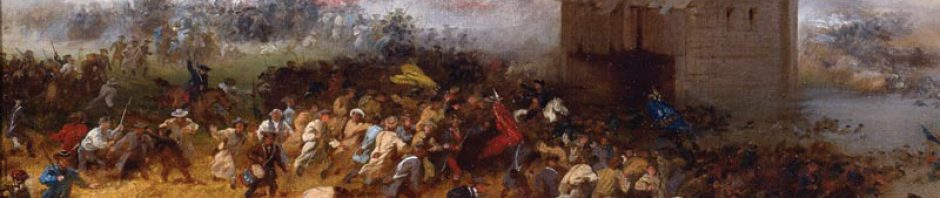
In August 1776, a group of soldiers—the Maryland 400—helped hold back the British Army at the Battle of Brooklyn, allowing the rest of the Americans to escape the field. The Marylanders lost a quarter of their men that day, but their stand saved the Continental Army, allowing it to live and fight another day. For […]
Revolutionary Book Review: George the Drummer Boy

The first book I ever read about the American Revolution was a children’s book called George the Drummer Boy, by Nathaniel Benchley, with illustrations by Don Bolognese. It tells the story of a drummer in the British Army who is stationed in Boston in 1775. His unit is chosen to march out of Boston to […]
A New Podcast Tells the Story of the Maryland Line
We are excited to share that a new podcast about the Revolutionary War, and Maryland’s soldiers, has been launched by Mission History. The series tells the story of the events that brought two armies, including nearly 2,000 soldiers from Maryland, to Camden, South Carolina in August 1781. The battle fought at Camden was one of […]
A Beating in Baltimore: Communal Violence during the Revolution
Today’s post comes from Marshall Cooperman of St. John’s College in Annapolis, who was part of the Maryland State Archives’ intern class of 2023. Marshall’s project team worked on cataloging a large collection of Revolutionary-era correspondence, and he came across the letters that tell this story while doing that work America in 1776 was a […]
Tag Archives: officers
What’s In a Name: Companies, Regiments, and Battalions
Revolutionary War military terminology can be pretty confusing. Starting today, we are publishing periodic posts to help explain what some of these words mean, moving towards a full glossary of eighteenth-century military terms.
Col. Gaither: Seven years on Georgia’s frontier
A new biography expands on previous writing on this blog about Henry Chew Gaither, a Revolutionary War captain of the First and Fourth Maryland Regiments. On the eve of the Battle of Brooklyn, he served as a witness for Daniel … Continue reading
Evaluating the Maryland Officers
In late 1776, Maryland expanded its military contribution to the Continental Army from one regiment to seven. This required a great deal of planning, as each new regiment required about 50 new officers, and so many promotions required much deliberation. … Continue reading
“Our officers…cared but little, if anything at all, about us.”
Our posts exploring officers’ duties have drawn from heavily from the work of Inspector General Continental Army, Fredrich Wilhelm von Steuben. His treatise on the Regulations for the Order and Discipline of the Troops of the United States lays out … Continue reading
Lamenting the Death of Major Archibald Anderson
Archibald Anderson began his military career as first lieutenant in 1776 and fought with the First Maryland Regiment at the Battle of Brooklyn. A capable and brave officer, Anderson rose quickly through the ranks, receiving a promotion to captain in … Continue reading
Second Lieutenant Thomas Goldsmith and the Battle of White Plains
Thomas Goldsmith’s military career began on January 3, 1776 when he was commissioned as a second lieutenant of Captain John Day Scott’s Seventh Company of the First Maryland Regiment.[1] As Frederick Wilhelm von Steuben detailed in his publication, “Regulations for … Continue reading
The role of a first lieutenant during the Revolutionary War
At the start of the American Revolution, the Continental Army did not have a concrete understanding of soldiers’ roles within a regiment and how to properly prepare for war. As a result, in 1779 Frederick Wilhelm von Steuben, Inspector General … Continue reading
The Trial of Lieutenant Steward
On September 23, 1776, Lieutenant John Steward of Maryland stood before a court martial on the Heights of Harlem. He had slapped a sergeant from Connecticut for cowardly behavior and then argued with, some would say threatened, a colonel who … Continue reading

 Finding the Maryland 400