Project sponsored by the Maryland Society of the Sons of the American Revolution

Recent posts: Finding the Maryland 400
Help Support the Maryland 400!
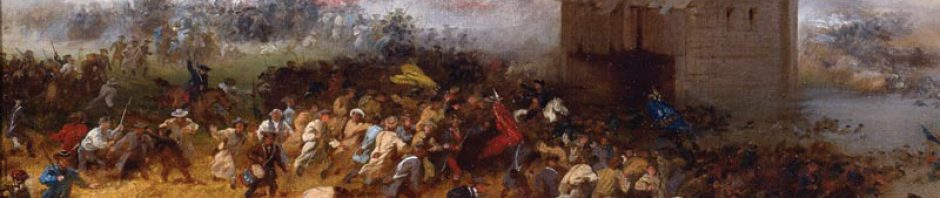
In August 1776, a group of soldiers—the Maryland 400—helped hold back the British Army at the Battle of Brooklyn, allowing the rest of the Americans to escape the field. The Marylanders lost a quarter of their men that day, but their stand saved the Continental Army, allowing it to live and fight another day. For […]
Revolutionary Book Review: George the Drummer Boy

The first book I ever read about the American Revolution was a children’s book called George the Drummer Boy, by Nathaniel Benchley, with illustrations by Don Bolognese. It tells the story of a drummer in the British Army who is stationed in Boston in 1775. His unit is chosen to march out of Boston to […]
A New Podcast Tells the Story of the Maryland Line
We are excited to share that a new podcast about the Revolutionary War, and Maryland’s soldiers, has been launched by Mission History. The series tells the story of the events that brought two armies, including nearly 2,000 soldiers from Maryland, to Camden, South Carolina in August 1781. The battle fought at Camden was one of […]
A Beating in Baltimore: Communal Violence during the Revolution
Today’s post comes from Marshall Cooperman of St. John’s College in Annapolis, who was part of the Maryland State Archives’ intern class of 2023. Marshall’s project team worked on cataloging a large collection of Revolutionary-era correspondence, and he came across the letters that tell this story while doing that work America in 1776 was a […]
Tag Archives: history
Help Support the Maryland 400!
In August 1776, a group of soldiers—the Maryland 400—helped hold back the British Army at the Battle of Brooklyn, allowing the rest of the Americans to escape the field. The Marylanders lost a quarter of their men that day, but … Continue reading
The Maryland 400’s Mutineer
In a recent post, we explored crime and punishment in the Continental Army. During the Revolutionary War, desertions and mutinies were crucial parts of the Continental soldier’s experiences. In the first year of war, 80 percent of criminal activity of the … Continue reading
The Midnight Attack on Stony Point
While each campaign year of the Revolutionary War had its own purpose and series of events, the main focus of the campaign of 1779 was to maintain the vital lines of communication between the Eastern and Southern states. George Washington … Continue reading
Military or Jail: The Interesting Case of Private Everit
During both the Korean War and the Vietnam War eras, many soldiers enlisted after being given a choice by a judge: Join the military or go to jail. Today, the military will not allow anyone who has been convicted of … Continue reading
“The misfortune which ensued”: The defeat at Germantown
On the morning of October 4, 1777, Continental troops encountered British forces, led by Lord William Howe, encamped at Germantown, Pennsylvania, in Philadelphia’s outskirts. George Washington believed that he had surprise on his side. [1] He had ordered his multiple divisions to march twenty … Continue reading
“Flecking the hedges with red”: Palmer’s Ballad on the Maryland 400
In the past, we have written about poems and songs relating to the Maryland 400. [1] They were celebrated years after and during the Revolutionary War, with newspapers often containing poems and songs. Such poems included one about William Sterrett in 1776 … Continue reading
British “masters of the field”: The disaster at Brandywine
On the night of September 10, 1777, many of the soldiers and commanding officers of the Continental Army sat around their campfires and listened to an ominous sermon that would predict the events of the following day. Chaplain Jeremias (or Joab) Trout … Continue reading
Persecuted in Revolutionary Baltimore: The Sufferings of Quakers
In March 1777, revolutionary leader John Adams wrote an angry letter to his wife, Abigail. He declared that Baltimore was a “dull place” where many of the town’s remaining inhabitants were Quakers, who he described as “dull as Beetles” and a “kind of neutral Tribe, … Continue reading
“Anxious of showing my zeal for the love of my Country, I entered myself as a Cadet…”
When Maryland put together its regiment as directed by the Continental Congress in 1776, it needed officers to command the troops. The regiment had nine companies, as well as seven independent companies. Each company had a captain and three lieutenants, … Continue reading
A “dull place” on the Patapsco: Baltimore and the Marr Brothers
In May 1776, the Revolution had been raging for almost a year with skirmishes between the British imperial army and the rag-tag revolutionaries. William Marr, probably with his brothers Nicholas and James, enlisted in the Continental Army in Capt. Nathaniel Ramsey’s … Continue reading

 Finding the Maryland 400