Project sponsored by the Maryland Society of the Sons of the American Revolution

Recent posts: Finding the Maryland 400
Help Support the Maryland 400!
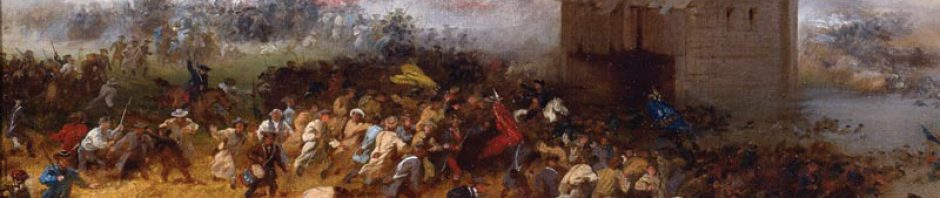
In August 1776, a group of soldiers—the Maryland 400—helped hold back the British Army at the Battle of Brooklyn, allowing the rest of the Americans to escape the field. The Marylanders lost a quarter of their men that day, but their stand saved the Continental Army, allowing it to live and fight another day. For […]
Revolutionary Book Review: George the Drummer Boy

The first book I ever read about the American Revolution was a children’s book called George the Drummer Boy, by Nathaniel Benchley, with illustrations by Don Bolognese. It tells the story of a drummer in the British Army who is stationed in Boston in 1775. His unit is chosen to march out of Boston to […]
A New Podcast Tells the Story of the Maryland Line
We are excited to share that a new podcast about the Revolutionary War, and Maryland’s soldiers, has been launched by Mission History. The series tells the story of the events that brought two armies, including nearly 2,000 soldiers from Maryland, to Camden, South Carolina in August 1781. The battle fought at Camden was one of […]
A Beating in Baltimore: Communal Violence during the Revolution
Today’s post comes from Marshall Cooperman of St. John’s College in Annapolis, who was part of the Maryland State Archives’ intern class of 2023. Marshall’s project team worked on cataloging a large collection of Revolutionary-era correspondence, and he came across the letters that tell this story while doing that work America in 1776 was a […]
Tag Archives: Army Life
Polearms in the Continental Army
Today, we have another post by one of our Washington College partners. Simon Belcher gives us an education about some of the bladed weapons that were used by the Continental Army during the Revolutionary War. During the Battle of Brooklyn, … Continue reading
What’s In a Name: Companies, Regiments, and Battalions
Revolutionary War military terminology can be pretty confusing. Starting today, we are publishing periodic posts to help explain what some of these words mean, moving towards a full glossary of eighteenth-century military terms.
Happy National Literacy Day! – Literacy Rates in Colonial America
In addition to the Revolutionary War, a literary revolution swept across the American Colonies and Europe in the 18th century. In celebration of National Literacy Day, today we will explore the literacy rates of Colonial America and how they affected … Continue reading
Crime and Punishment in the Continental Army
From the beginning of the Revolutionary War, the American military justice system was governed by the articles of war, adopted on June 30, 1775. They were extremely similar to those used by the British enemy, and although both relied heavily … Continue reading
The Significance of December 10, 1776
If you’ve read a few biographies of the men of the Maryland 400, you may have noticed that many of the troops reenlisted on December 10, 1776. This is not a coincidence, but is the outcome of the reorganization of … Continue reading
Sickened Marylanders and the Philadelphia Bettering House
On April 13, 1777, John Adams described the spread of disease in Philadelphia and the fate of the sick soldiers in that city in a letter to his wife, Abigail Smith. In his letter, he mentioned a local institution, called the … Continue reading
“Games of Exercise” During the American Revolution
With the Olympics in full swing, this is a good time to talk about the athletic pastimes of American soldiers during the Revolutionary War. Active campaigning took a relatively small part of the year during the American Revolution, and as … Continue reading
“Anxious of showing my zeal for the love of my Country, I entered myself as a Cadet…”
When Maryland put together its regiment as directed by the Continental Congress in 1776, it needed officers to command the troops. The regiment had nine companies, as well as seven independent companies. Each company had a captain and three lieutenants, … Continue reading
Evaluating the Maryland Officers
In late 1776, Maryland expanded its military contribution to the Continental Army from one regiment to seven. This required a great deal of planning, as each new regiment required about 50 new officers, and so many promotions required much deliberation. … Continue reading
“Our officers…cared but little, if anything at all, about us.”
Our posts exploring officers’ duties have drawn from heavily from the work of Inspector General Continental Army, Fredrich Wilhelm von Steuben. His treatise on the Regulations for the Order and Discipline of the Troops of the United States lays out … Continue reading

 Finding the Maryland 400