Project sponsored by the Maryland Society of the Sons of the American Revolution

Recent posts: Finding the Maryland 400
Help Support the Maryland 400!
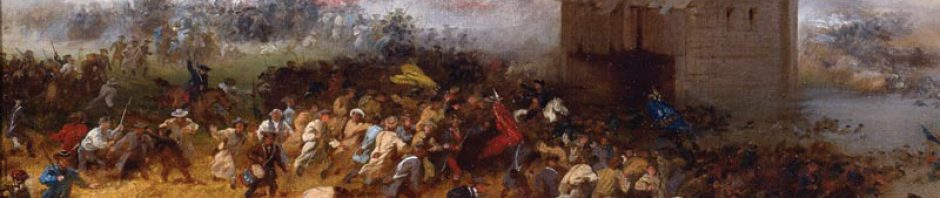
In August 1776, a group of soldiers—the Maryland 400—helped hold back the British Army at the Battle of Brooklyn, allowing the rest of the Americans to escape the field. The Marylanders lost a quarter of their men that day, but their stand saved the Continental Army, allowing it to live and fight another day. For […]
Revolutionary Book Review: George the Drummer Boy

The first book I ever read about the American Revolution was a children’s book called George the Drummer Boy, by Nathaniel Benchley, with illustrations by Don Bolognese. It tells the story of a drummer in the British Army who is stationed in Boston in 1775. His unit is chosen to march out of Boston to […]
A New Podcast Tells the Story of the Maryland Line
We are excited to share that a new podcast about the Revolutionary War, and Maryland’s soldiers, has been launched by Mission History. The series tells the story of the events that brought two armies, including nearly 2,000 soldiers from Maryland, to Camden, South Carolina in August 1781. The battle fought at Camden was one of […]
A Beating in Baltimore: Communal Violence during the Revolution
Today’s post comes from Marshall Cooperman of St. John’s College in Annapolis, who was part of the Maryland State Archives’ intern class of 2023. Marshall’s project team worked on cataloging a large collection of Revolutionary-era correspondence, and he came across the letters that tell this story while doing that work America in 1776 was a […]
Tag Archives: American Revolution
The Maryland 400’s Veterans
The mission of Finding the Maryland 400 is to pay tribute to Maryland’s Revolutionary War veterans. Today, however, we want to focus on the members of the First Maryland Regiment who were already veterans before the unit’s first battle in … Continue reading
Victory at Yorktown!
On October 19, 1781, British General Charles, Lord Conwallis surrendered his army of more than 8,000 men to George Washington at Yorktown, Virginia. Cornwallis’s action brought an end to a siege which had lasted nearly two weeks. It was also … Continue reading
Which Private Smith is the Right Private Smith?
Piecing together service records of Revolutionary War soldiers can be complicated. No one got a DD 214 when they were mustered out. Many soldiers had their service records compiled by the Federal Government in the late nineteenth century, and applications for … Continue reading
British “masters of the field”: The disaster at Brandywine
On the night of September 10, 1777, many of the soldiers and commanding officers of the Continental Army sat around their campfires and listened to an ominous sermon that would predict the events of the following day. Chaplain Jeremias (or Joab) Trout … Continue reading
Persecuted in Revolutionary Baltimore: The Sufferings of Quakers
In March 1777, revolutionary leader John Adams wrote an angry letter to his wife, Abigail. He declared that Baltimore was a “dull place” where many of the town’s remaining inhabitants were Quakers, who he described as “dull as Beetles” and a “kind of neutral Tribe, … Continue reading
“Games of Exercise” During the American Revolution
With the Olympics in full swing, this is a good time to talk about the athletic pastimes of American soldiers during the Revolutionary War. Active campaigning took a relatively small part of the year during the American Revolution, and as … Continue reading
A “dull place” on the Patapsco: Baltimore and the Marr Brothers
In May 1776, the Revolution had been raging for almost a year with skirmishes between the British imperial army and the rag-tag revolutionaries. William Marr, probably with his brothers Nicholas and James, enlisted in the Continental Army in Capt. Nathaniel Ramsey’s … Continue reading
“He had never gave them an inch before he found that he had nothing left to keep them off with”
In late August 1777, the American Army planned a raid on Staten Island. Intelligence available to the Americans suggested that the British forces there were primarily American Loyalist militia rather than British regular troops. Furthermore, the inexperienced Tories were stealing … Continue reading

 Finding the Maryland 400