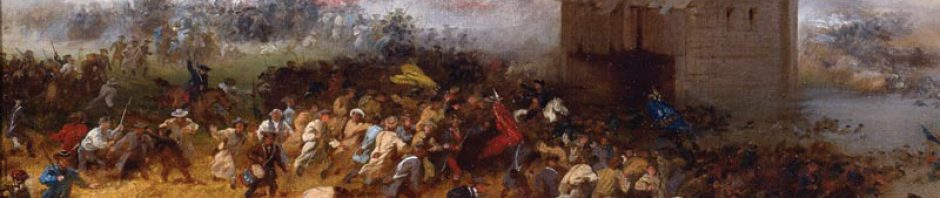
Where were the Maryland 400 Buried?

We frequently receive questions about where the Maryland 400 are buried. Popular folklore, advanced by prominent historians and public figures like Sir Patrick Stewart, suggests that a single mass grave existed, traditionally said to be located on Brooklyn’s Third Avenue between Seventh and Eighth Street. A more recent version of this theory suggested that a mass burial ground existed beneath a concrete lot between Ninth Street and Third Avenue. Following an archaeological study of the lot in 2017, we know there are no human remains there. However, a mystery still remains: Where did those brave soldiers who sacrificed their lives on August 27, 1776 likely end up? 

amerlegionbrooklynburial

This New York State Historic Marker, located outside of Brooklyn’s American Legion Post 1636, honors the Marylanders who fought at the Battle of Brooklyn but does not tell the entire story.

Continue reading

Posted in Maryland 400 | 6 Comments

August 26, 1776: The Day Before

Tomorrow is August 27, the 243rd anniversary of the Battle of Brooklyn. It is a day which is commemorated every year. Today, however, I would like to mark another day: August 26, the day before.

August 26, 1776 was a Monday. There were, at the time, just under 1,000 Marylanders encamped in Manhattan. Most of them had been there since the beginning of the month, although about 200 soldiers, members of the Fourth Independent and Fifth Independent companies, had arrived within the last week or so. Consequently, they would play only a limited role at the battle. All of them, however, were aware that a battle was imminent.

Continue reading

Posted in Maryland 400 | Tagged | Comments Off on August 26, 1776: The Day Before

The Second War with Britain: The Legacy of the Maryland 400 in the War of 1812

Some members of the Maryland 400 who survived the Revolutionary War’s trials later faced other challenging moments in the War of 1812. The divisive war once again tested the mettle of the Revolutionary War veterans in political office and on the battlefield. While the War of 1812 cemented the legacies of some, it also harmed the legacies of others. Militia officers often earned their positions because of their reputation rather than their military prowess, which possibly contributed to their flaws. Today’s post will look at the legacy of five soldiers from the Maryland 400 by examining their roles in the War of 1812. Continue reading

Posted in Maryland 400 | 6 Comments

“Gross Outrage”: An Independence Day Celebration Gone Wrong

During my recent research of Adjutant Jacob Brice, I came across a place I had never heard of in relation to the Revolutionary War, called Haddrell’s Point in South Carolina. Brice was wounded and captured at the Battle of Camden in 1781 and was held at Haddrell’s Point as a prisoner of war. [1] Continue reading

Posted in Maryland 400 | 3 Comments

“Determined to Run the Risk of Being Hanged”: The Enlistment Feud between the Second and Fifth Maryland Regiments

In my last post, I discussed a few examples of the enlistment problems plaguing former members of the Maryland 400 in 1777. Some of the examples focused on a growing feud between Captain Archibald Anderson of the Second Maryland Regiment and Captain William Frazier of the Fifth Maryland Regiment. Both had previously worked together as lieutenants in the Fourth Independent Company, and both wanted their former soldiers to join their companies. The Maryland Council of Safety stated that former members of the Independent Companies should enlist in the Second Regiment, yet some soldiers wanted to join other regiments. Some of the soldiers of the Fourth Independent particularly seemed to dislike Anderson, and wanted to avoid serving under him again. Frazier gladly recruited his former soldiers into his company, eager to make use of their experience as hardened veterans, although this led to conflicts with Anderson as discussed last week. This week’s post will look more in depth into the feud between the two regiments. [1] Continue reading

Posted in Maryland 400 | 5 Comments

“Not So Genteel” Behavior: Enlistment Issues Involving the Maryland 400

In September of 1776, the Continental Congress decided to restructure the Continental Army, hoping to recruit a larger number of troops. To this end, Congress ordered the creation of 88 new regiments, with quotas set for each state based on their population, and extended enlistment terms to three years. Congress set a quota of eight regiments for Maryland. In late December of 1776, Congress ordered the enlistment of another 16 regiments. With officers already struggling to meet the enlistment quotas put in place by the first order of 88 regiments, competition for new recruits only intensified. [1]

Although Congress did not request additional regiments from Maryland, Pennsylvania and Virginia recruited soldiers from Maryland for their own quotas. Tensions over recruitment remained strong between different Maryland regiments as well. Soldiers sometimes enlisted in multiple companies to receive multiple enlistment bonuses, which officers overlooked to meet their quotas. Today’s post will examine some specific examples of competition over the recruitment of former members of the Maryland 400 within a broader context. [2] Continue reading

Posted in Maryland 400 | 4 Comments

“Unfit for Duty”: Medicine and Illness in the Revolutionary War

This week, I finished writing biographies for Maryland 400 soldiers. Over the course of my research on various soldiers, I have written about quite a few who fell sick during their service, including the soldier I am currently researching, Christopher Richmond, who was furloughed from May to October in 1778. Since I have encountered so many soldiers who were ill during their service, I decided to look into what kind of medical conditions and treatments faced the American troops during the war. Continue reading

Posted in Maryland 400 | 5 Comments

The Fourth of July, 1776

Today, we celebrate the signing of the Declaration of Independence in Philadelphia on July 4, 1776. The news of that event reached Annapolis a day or two later, where it was received by the thousand or so soldiers who were preparing to fight in defense of that declaration. Some of those soldiers, the men this project focuses on, marched north to defend New York less than a week later. Two of them, Alexander Ferguson and George Claypoole, wrote out their wills just before departing; click on their names to learn more.

As we celebrate the Fourth of July and take time to remember the American Revolution, stories about the Revolutionary War often appear in the news. Recently, we were able to contribute to this piece, about an enslaved African American Revolutionary War soldier from Maryland:

Twice Denied the Freedom He’d Fought For, Black Revolutionary War Hero From Maryland to be Honored at Last [Baltimore Sun]

You can read other Revolutionary War news stories from the past here:

You can also read some of our earlier posts about the weeks leading up to the Declaration of Independence here:

Have a happy Fourth!

–Owen

Posted in Maryland 400 | Comments Off on The Fourth of July, 1776

Rebel Quakers: The Struggle Between Faith and Liberty

Last week, I began researching Richard Besswick, a private in the First Maryland Regiment and a member of the Maryland 400. In the course of my search for information about his life, I came across the will of Nathan Besswick from 1778. I had a hunch that this could possibly be Richard’s father, so I went to the stacks and pulled the record to find out. Sure enough, Nathan Besswick mentioned a son named Richard who was about the same age as the Richard Besswick I was looking for. More interesting, however, was something I found at the end of the will. I almost didn’t read it, since I had already gathered all of the information that can typically be found in a will. Luckily, I did decide to read it, and what I found deepened Richard Besswick’s story significantly. Continue reading

Posted in Maryland 400 | 4 Comments

A Tale of Two Jeffers: How Pension Information Differentiates Revolutionary War Soldiers

The first biography I wrote for Finding the Maryland 400 covered the life of Jacob Jeffers, a soldier who served in Maryland’s Fourth Independent Company during the Battle of Brooklyn. Jeffers later served in the Second Maryland Regiment until his discharge from the service in 1780. Most of the important information used in his biography came from various muster rolls. Research derived from other sources is sometimes left out because that information cannot be connected to soldiers who served in the Maryland Line. Census information, for example, is useful for corroborating information from other sources, but is often too vague to connect to a specific soldier. There are multiple people named Jacob Jeffers in the 1790 federal census, but none of them can be definitively linked to the Fourth Independent Company. This also means that we are often able to trace the movements of more than one person through our research. My post today will discuss the history of another Jacob Jeffers who also served in the Maryland Line. [1]

Unlike the Jacob Jeffers who served in the Fourth Independent Company, this Jacob Jeffers—a free African-American Maryland soldier—applied for a federal pension as a Revolutionary War veteran. Pension applications are extremely useful in learning about a soldier’s wartime service as well as their personal life. Because of his pension, more information about this Jacob Jeffers is available than the Jacob Jeffers who served in the Fourth Independent. [2] Continue reading

Posted in Biographies, Maryland 400, Revolutionary Veterans | 2 Comments