Project sponsored by the Maryland Society of the Sons of the American Revolution

Recent posts: Finding the Maryland 400
Help Support the Maryland 400!
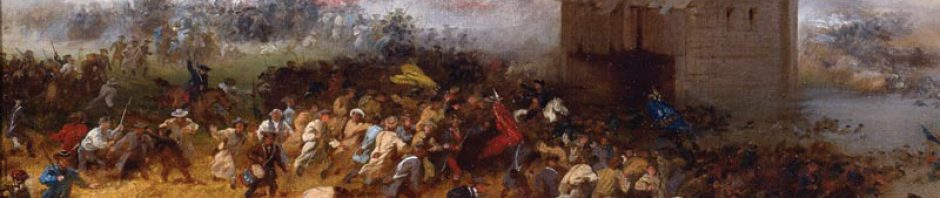
In August 1776, a group of soldiers—the Maryland 400—helped hold back the British Army at the Battle of Brooklyn, allowing the rest of the Americans to escape the field. The Marylanders lost a quarter of their men that day, but their stand saved the Continental Army, allowing it to live and fight another day. For […]
Revolutionary Book Review: George the Drummer Boy

The first book I ever read about the American Revolution was a children’s book called George the Drummer Boy, by Nathaniel Benchley, with illustrations by Don Bolognese. It tells the story of a drummer in the British Army who is stationed in Boston in 1775. His unit is chosen to march out of Boston to […]
A New Podcast Tells the Story of the Maryland Line
We are excited to share that a new podcast about the Revolutionary War, and Maryland’s soldiers, has been launched by Mission History. The series tells the story of the events that brought two armies, including nearly 2,000 soldiers from Maryland, to Camden, South Carolina in August 1781. The battle fought at Camden was one of […]
A Beating in Baltimore: Communal Violence during the Revolution
Today’s post comes from Marshall Cooperman of St. John’s College in Annapolis, who was part of the Maryland State Archives’ intern class of 2023. Marshall’s project team worked on cataloging a large collection of Revolutionary-era correspondence, and he came across the letters that tell this story while doing that work America in 1776 was a […]
Category Archives: Revolutionary Veterans
A Tale of Two Jeffers: How Pension Information Differentiates Revolutionary War Soldiers
The first biography I wrote for Finding the Maryland 400 covered the life of Jacob Jeffers, a soldier who served in Maryland’s Fourth Independent Company during the Battle of Brooklyn. Jeffers later served in the Second Maryland Regiment until his … Continue reading
Revolutionary Veterans VI: The Long and Eventful Life of William McMillan
Regular readers of Finding the Maryland 400 will already know about William McMillan. As a 20 year old sergeant at the Battle of Brooklyn, McMillan survived a battle where “My captain was killed, first lieutenant was killed, second lieutenant shot … Continue reading
Revolutionary Veterans V: Thomas Stockett Brewer of Annapolis
Thomas Stockett Brewer also remained in his home state after the war. Brewer hailed from Anne Arundel County and likely lived in Annapolis before the war, where he was surrounded by patriotic sentiment. He likely worked as an apprentice or … Continue reading
Revolutionary Veterans IV: The Tragic Fate of James Marle
James Marle, a young man who enlisted as a fifer but was instead given a musket, shows the other reality that many veterans faced when they left Maryland. Originally from Baltimore County, Marle joined the military to be a musician … Continue reading
Revolutionary Veterans III: Leonard Watkins, gearmaker
Leonard Watkins decided to permanently return to his home in Montgomery County, Maryland, after the Revolution ended. Being a craftsman, Watkins did not face the same struggles that many of his fellow soldiers dealt with in acquiring land or growing … Continue reading
Revolutionary Veterans II: Levin Frazier, Soldier, Sailor, Land Owner
Levin Frazier, a farmer from Dorchester County, illustrates the possibilities of success for the veterans who chose to remain in Maryland after the war. He was born a poor man in his home county, and it is unlikely that he … Continue reading
Revolutionary Veterans I: Mark McPherson, Kentucky Gentleman
Mark McPherson, a planter born in Maryland to a marginally successful family, left his home state despite having land and means in Maryland. A resident of Charles County, he inherited land from parents who died while he was still young. … Continue reading
The Fates of Revolutionary War Veterans
Today, the Revolutionary War is remembered as a triumph of liberty, a great struggle for the ideal of freedom that the American colonists so greatly desired. In truth, however, it was much more. The Revolution was not just a war … Continue reading

 Finding the Maryland 400