Project sponsored by the Maryland Society of the Sons of the American Revolution

Recent posts: Finding the Maryland 400
Help Support the Maryland 400!
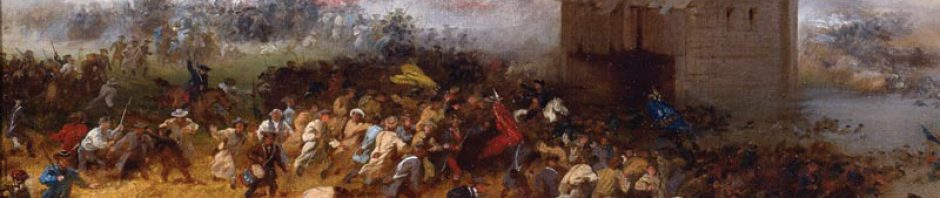
In August 1776, a group of soldiers—the Maryland 400—helped hold back the British Army at the Battle of Brooklyn, allowing the rest of the Americans to escape the field. The Marylanders lost a quarter of their men that day, but their stand saved the Continental Army, allowing it to live and fight another day. For […]
Revolutionary Book Review: George the Drummer Boy

The first book I ever read about the American Revolution was a children’s book called George the Drummer Boy, by Nathaniel Benchley, with illustrations by Don Bolognese. It tells the story of a drummer in the British Army who is stationed in Boston in 1775. His unit is chosen to march out of Boston to […]
A New Podcast Tells the Story of the Maryland Line
We are excited to share that a new podcast about the Revolutionary War, and Maryland’s soldiers, has been launched by Mission History. The series tells the story of the events that brought two armies, including nearly 2,000 soldiers from Maryland, to Camden, South Carolina in August 1781. The battle fought at Camden was one of […]
A Beating in Baltimore: Communal Violence during the Revolution
Today’s post comes from Marshall Cooperman of St. John’s College in Annapolis, who was part of the Maryland State Archives’ intern class of 2023. Marshall’s project team worked on cataloging a large collection of Revolutionary-era correspondence, and he came across the letters that tell this story while doing that work America in 1776 was a […]
Author Archives: Finding the Maryland 400
James Farnandis meets George Washington
James Farnandis was the ensign of the First Company when the British captured him at the Battle of Brooklyn on August 27, 1776. Farnandis remained a prisoner of the British in New York until his exchange on March 24, 1777. … Continue reading
The role of a first lieutenant during the Revolutionary War
At the start of the American Revolution, the Continental Army did not have a concrete understanding of soldiers’ roles within a regiment and how to properly prepare for war. As a result, in 1779 Frederick Wilhelm von Steuben, Inspector General … Continue reading
Maryland 400 Presentation
If you’d like to learn about the Maryland 400, and you happen to be able to come to Annapolis next Wednesday, June 10, at noon, then you’re in luck!
“Winged Messenger of Death”: Captain Edward De Coursey’s Letter to a Friend
Captain Edward De Coursey’s April 1777 letter to his friend James Hollyday is one of the most unique documents relating to an individual soldier from the Maryland 400. As the third lieutenant in the Seventh Independent Company, De Coursey fought … Continue reading
Introduction for Joshua Rifkin
Hi everyone, My name is Joshua Rifkin, and I have the honor of interning at the Maryland State Archives for the summer, where I will be continuing the research of the Maryland 400. I graduated from the Park School of … Continue reading
The Short Life of Capt. Daniel Bowie
Daniel Bowie had been a soldier for seven months, and a captain for just seven weeks, when he wrote out his will on August 26, 1776, the day before he was mortally wounded at the Battle of Brooklyn. We have … Continue reading
Defeats and Doubts: The Continental Army in 1776
William Harrison served as the first lieutenant in the Seventh Independent Company when the company fought alongside the First Maryland Regiment at the Battle of Brooklyn.
The Court-Martial of Lieutenant Kidd
Lieutenant John Kidd served in the First Maryland Regiment when it fought at the Battle of Brooklyn in August 1776. Although Kidd managed to survive the battle and make it back to the American lines at Brooklyn Heights, his days … Continue reading
Men who “could stand cutting”: The Old Maryland Line
The famed Maryland 400 were not the only Revolutionary War soldiers hailed as heroes. Indeed, throughout the war, the Maryland Line (as the state’s contribution to the Continental Army was called) developed a reputation for skill and bravery. They were … Continue reading
Corporal Zachariah Gray’s Last Will and Testament
Corporal Zachariah Gray may have been the oldest enlisted man in the First Maryland Regiment when the regiment fought at the Battle of Brooklyn. At the time of his enlistment on February 3, 1776 Gray was forty-five years old, significantly … Continue reading

 Finding the Maryland 400