Project sponsored by the Maryland Society of the Sons of the American Revolution

Recent posts: Finding the Maryland 400
Help Support the Maryland 400!
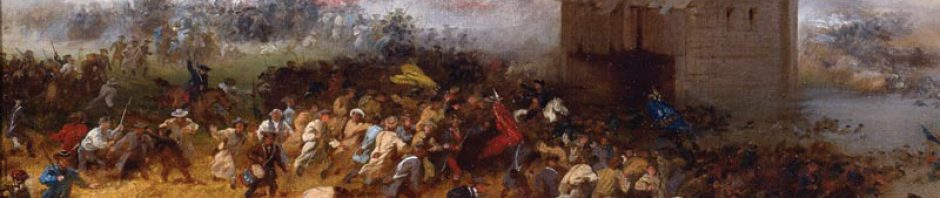
In August 1776, a group of soldiers—the Maryland 400—helped hold back the British Army at the Battle of Brooklyn, allowing the rest of the Americans to escape the field. The Marylanders lost a quarter of their men that day, but their stand saved the Continental Army, allowing it to live and fight another day. For […]
Revolutionary Book Review: George the Drummer Boy

The first book I ever read about the American Revolution was a children’s book called George the Drummer Boy, by Nathaniel Benchley, with illustrations by Don Bolognese. It tells the story of a drummer in the British Army who is stationed in Boston in 1775. His unit is chosen to march out of Boston to […]
A New Podcast Tells the Story of the Maryland Line
We are excited to share that a new podcast about the Revolutionary War, and Maryland’s soldiers, has been launched by Mission History. The series tells the story of the events that brought two armies, including nearly 2,000 soldiers from Maryland, to Camden, South Carolina in August 1781. The battle fought at Camden was one of […]
A Beating in Baltimore: Communal Violence during the Revolution
Today’s post comes from Marshall Cooperman of St. John’s College in Annapolis, who was part of the Maryland State Archives’ intern class of 2023. Marshall’s project team worked on cataloging a large collection of Revolutionary-era correspondence, and he came across the letters that tell this story while doing that work America in 1776 was a […]
Author Archives: Finding the Maryland 400
The British Diversion
The Marylanders were called to battle before sunrise on August 27, 1776. Lord Stirling, the temporary commander of the Maryland troops, was awoken at around three o’clock in the morning and given the news that the British had begun their … Continue reading
The Marylanders Arrive
On August 26, 1776, the Marylanders arrived at Long Island on the eve of battle. Once it became clear that a major engagement was imminent, Washington sent the regiment to reinforce the American defensive line. The men who would become … Continue reading
“They Must Be Well Watched”
After the British landed on Long Island they advanced to within three miles of the American lines, and then they stopped. On August 23, 1776, the tension grew in New York as the American leadership tried to determine the enemy’s … Continue reading
The British Come Ashore
On August 22, 1776, the British began setting the stage for battle by landing troops on Long Island. The Continental Army had been present in varying numbers on Long Island for nearly four months, since General Nathanael Greene was ordered … Continue reading
In Their Own Words: An Oral History of the Battle of Brooklyn, Part II
This is Part II of our compilation of personal accounts of the Battle of Brooklyn by members of the First Maryland Regiment. If you missed Part I, you can read it here. Around midday on August 27, 1776, the British … Continue reading
In Their Own Words: An Oral History of the Battle of Brooklyn
Next week marks the 238th anniversary of the Battle of Brooklyn. Beginning Friday, we will be provide updates of the battle as it unfolded. In preparation for that, over the next two days, we are publishing a compilation of several … Continue reading
A History of Service
By May of 1776, 28 year old David Congleton enlisted as a private in the Fifth Company of the First Maryland Regiment, where he would serve during the Battle of Brooklyn. Following his initial one year service agreement, Congleton reenlisted … Continue reading
Demographics in the First Maryland Regiment
A former member of the Fifth Company who fought at the Battle of Brooklyn, John Burgess was described as a slender, 42-year-old man, with light brown hair, a “swarthy” complexion, and a height of five feet eleven inches, who was … Continue reading
So We Meet Again
During the Battle of Brooklyn, the First Maryland Regiment lost approximately one third of their total troop strength.[1] Casualties were substantially higher in the Third, Fourth, Sixth, Seventh Independent, and Ninth Companies who were forced to make a last stand … Continue reading
Brothers in Arms
During the Revolutionary War, it was not uncommon for multiple men of the same immediate family to enlist. Some brothers, like Samuel and William McMillan, enlisted in the same company, while other sets of siblings dispersed and entered separate companies … Continue reading

 Finding the Maryland 400