Today’s post comes from Marshall Cooperman of St. John’s College in Annapolis, who was part of the Maryland State Archives’ intern class of 2023. Marshall’s project team worked on cataloging a large collection of Revolutionary-era correspondence, and he came across the letters that tell this story while doing that work
America in 1776 was a society on the brink, riven by the question of independence. Not all colonists supported independence from England. Some opposed the revolution passively and peacefully, but others turned to violence. Maryland in particular suffered a great deal of political struggle and strife during the war. In some areas, especially the Eastern Shore, the level of pro-British sentiment made the daily operation of government almost impossible. Baltimore was a microcosm of the internal Revolutionary struggle: it had a large population of Loyalists, a sizable community of Quakers who opposed independence on religious grounds, and Maryland’s most militant pro-Revolution organization, the Whig Club.
Preexisting class, racial, and religious tensions all served to make the already severe civil strife caused by the war even more dangerous and violent. Many Marylanders resented the state’s elite leaders, and some felt the revolution was, in the words of the loyalist Alexander Magee, “not calculated or designed for the defense of American liberty or property, but for the purpose of enslaving the poor people.”1

In November 1776, all these tensions simmered in the background as a horse-drawn cart driven by militia captain James Bosely and his partner, James Smith, rattled down the road to the plantation of Vincent Trapnall. They were working on behalf of the Baltimore Committee of Observation, the county’s government, charged with collecting fines from those who refused to enroll in the militia. Trapnell was one such non-enroller, and dealing with him was dangerous business.
Bosely had visited Trapnall before, showing him a list of men who owed fines–including Trapnell–and said he would be back in a month to collect. In response, Bosely said, “Trapnall had damned me, shaking a Grape vine with a large end to it at me” and swore that “he would do for me” if the two of them had been alone. “[H]e then rode away threatening me with abusive Language.” Bosely and Smith also claimed they had been warned by Trapnell’s neighbors that he planned to shoot Bosely if he attempted to collect the fine.2
Despite having good reason to fear violence, the two men were unprepared for a fight when they came back to Trapnall’s plantation on November 14. Neither carried a gun, and though Smith had a sword, Bosely had ordered him “not by any means to strike [Trapnall].” As they rode up, Trapnall was chopping a log and “immediately dropped the ax and the piece of timber and run to his dwelling house saying all the way that he…would be damned if he did not blow James Bosley’s brains out.”3 Trapnall reached the house but was stopped at the door by his wife, who blocked his way, “urging and begging of him not to get his gun.”4 Trapnall instead grabbed a large stick and, according to Smith:
run up to Bosley and laid on with both of his hands upon him while he was on his horse, which cut him very bad upon his head. I suppose he lost half a pint of blood from the wound…
[Trapnall] damned all the Committee [of Observation] for a pack of damned rogues, and they might kiss his arse, and that if they was there he would serve them in the same manner as what I have done Bosley, and that he would not give him the liberty of going to the Committee but would kill him before [he did], throwing at Bosley stones and every thing that came in his way, as he was riding to leave him, and after he left Bosley and returned to me and made an offer to strike me, and swore he had a great mind to give it to me.5
Retreating, Bosely and Smith made their way to a neighboring plantation, where Bosely’s wounds were sewn up. Both men felt lucky to be alive. Trapnall had won a temporary victory, preventing the fine from being collected and showing that agents of the state were liable to be attacked. In the long run, however, Trapnall miscalculated. He had shown himself not just as a non-enroller in the militia–of whom there were many–but as a violent opponent of the state.
Bosely wrote to the Baltimore Committee of Observation, and informed them of the attack. The committee took the case seriously, regarding it as a symptom of an increasingly dangerous political situation. Its leaders wrote to the Council of Safety in Annapolis, the executive branch of the state, declaring that the Trapnall case showed how the “spirit of violence and opposition to the measures which have been adopted for our common safety, grows extremely daring and outrageous in this county.” The committee warned that “speedy and vigorous measures are necessary to preserve union among the People, and effectually to destroy the rising hopes of internal enemies.”6
Seeking to enforce the fines, the Baltimore Committee of Observation found itself between a rock and a hard place. Although the fines allowed people of sufficient means to avoid serving in the militia, they also raised money for the war effort. Perhaps equally important, they placated those who willingly served by punishing those who did not. The fines were deeply resented by those who were forced to pay, but failure to enforce the fines infuriated the militia, who threatened to “lay down their arms unless the fines of non-enrollers who daily insult them are strictly collected.” The Baltimore Committee wanted a crackdown on the loyalists, and requested instructions on how to proceed. On November 25, the council wrote back, directing the Baltimore government to summon and depose the principal actors in the incident, including Bosely and Trapnall.7
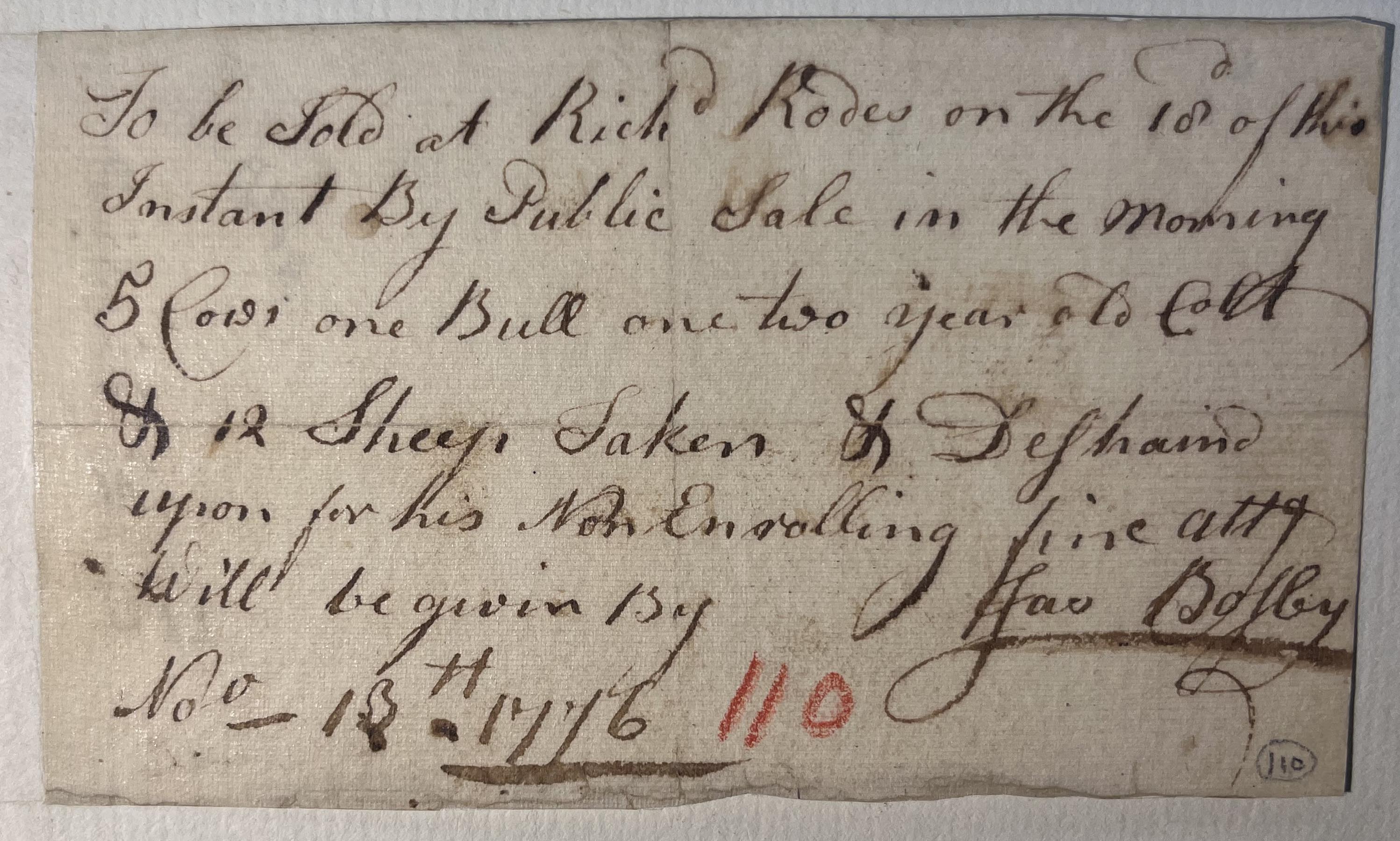
While the council deliberated over its response, Trapnall and Bosely clashed again. Bosely had gone with a group of other men to sell goods that had been confiscated as a fine from Richard Rodes, another non-enroller. As Bosely and the others arrived at Rodes’ plantation, they were met at the gate by the owner, backed by as many as twenty armed men. Rodes came through the gate and warned Bosely not to carry out the sale. According to Aquila Willmott, who said he had come to watch the sale as a spectator, Bosely asked to speak privately with Rodes. As the two walked away, none other than Vincent Trapnall came out of the crowd. He approached Willmott and asked if Bosely had ordered him to come along. Willmott said no. Trapnell then told Willmott that if Bosely kept trying to collect fines by seizing property and selling it, then Bosely would “be as surely killed, as he was born, and that there were men there at that time, who came on purpose to kill him, and that he [Trapnell] came to save his life, and that he wanted to talk to Capt. Bosley, and advised him to quit, for it was a damned piece of roguery.”8
As soon as Bosely and Rodes finished speaking, Trapnall told Bosely to return home or he would certainly be killed. Admitting he was outmatched by the armed men arrayed against him, Bosely informed the assembled company that he would leave–but also promised he would soon return with a group of militia to ensure that the sale went ahead. Trapnall replied that he could “raise 500 men before night to join him, and 1500 before Saturday night if he wanted them, and further asked Capt. Bosley where the artillery company was, as he heard he intended to bring them and they were ready to face them at any time.”9 While Trapnall may have been exaggerating the size of the force he could raise, his willingness to threaten the life of a militia officer and call for open rebellion speaks to the confidence with which some opponents of the revolution acted in Baltimore County in 1776.
Refusing to testify before the Council of Safety, Trapnall instead offered a list of nine men to give depositions supporting his account of the incident, claiming that no one tried to stop the sale of Rodes’ property and that no one threatened Bosely. John Willmott and Aquila Willmott, as well as James Bosely and his brother Charles, testified that Trapnall and Rodes had threatened Bosely and promised to raise an armed force to prevent the sale.10
If Trapnall indeed mustered depositions from nine supporters, they cannot all found in the records of the Maryland Council of Safety. The ones that do exist are nearly identical, in some cases down word fo rword. The deposition of Charles Pocer is representative. He related that:
Bosley said unto the said Rodes I suppose you will not let me sell to-day, and the said Rodes reply was, you may do as you please. And [the group] did not oppose the said James Bosley from selling any goods or chattels, nor neither was there any clubs or sticks more than the said [Trapnall] had in his hand, which was a small walking cane and [Bosley] was not opposed in any way, but desired [Bosley] to let matters lie till they could get some redress from the committee.11
Despite the many depositions in Trapnall’s favor, on January 29, 1777, the Council of Safety ordered his arrest. Indeed, the large number of depositions in support of Trapnall may have harmed his case, leading the Council to conclude that a substantial group of Loyalists truly was present at Rodes’ plantation when Bosely arrived. The depositions in favor of Bosely are more descriptive, colorfully capturing the vulgar tone of Trapnall’s conversation. But perhaps the strongest piece of evidence against Trapnall and Rodes is that, in fact, the planned sale of seized goods did not take place. There would be no reason for Bosely and his men to cancel the sale unless they felt threatened or intimidated.12
Trapnall later wrote a petition from jail admitting guilt and asking to be released. However, he maintained that he had committed his offenses only “through distraction & inadvertency.”13 He promised that he would never again be disloyal and that his crimes had been directed against Bosely alone, as an individual, and not against the state. Once Trapnall had taken an oath of allegiance to the state, the Council approved his release in exchange for “Security in the sum of one thousand pounds for his good behaviour and personal appearance at next Baltimore Court to answer such charges as may be alleged against him.”14 Whether Trapnall actually became a loyal citizen and supporter of the Revolution after his stint in prison is unknown, but the massive sum demanded for his bail indicates that the Council had some doubts about his sincerity.

Together with other instances of loyalist violence and protest in Baltimore, the Trapnall case had significant consequences not only for the individuals involved but also for the broader political situation in Baltimore. Following the Committee of Observation’s near panic about the danger of loyalist activity and failure to collect fines for non-enrollment, it began to tolerate and tacitly support the Whig Club, a pro-independence vigilante organization that took the law into its own hands and started a campaign of threats and violence against loyalists in December 1776. State authorities tamped down the Whig Club’s activities the next year, and for the most part open conflict was kept to a minimum.15
The standoff at Richard Rodes’s farm was typical in that regard. It ended with threats of a battle between militia units, but no armed groups ever fought, sparing Maryland the kind of internal violence that plagued other states, like South Carolina. Tensions remained under the surface, however, which did not disappear with the end of the Revolution.
Notes:
1. Examination of Alexander Magee, 29 August 1776, Maryland State Papers, Red Books, vol. 13, item 54, S989-18.
2. Journal and Correspondence of the Maryland Council of Safety, January 1-March 20, 1777, Archives of Maryland Online, vol. 16, p. 98.
3. AOM 16:93.
4. Deposition of James Bosely, 18 November 1776, Maryland State Papers, Red Books, vol. 11, item 100, S989-16.
5. AOM 16:93.
6. AOM 16:87.
7. AOM 16:87-88.
8. AOM 16:91.
9. AOM 16:92.
10. AOM 16:89, 91, 92, 98.
11. AOM 16:90-91.
12. AOM 16:86.
13. Vincent Trapnall to General Assembly, after 29 January 1777, Maryland State Papers, Red Books, vol. 11, item 98, S989-16.
14. AOM 16:153.
15. Charles Steffen, The Mechanics of Baltimore (Chicago: University of Illinois Press, 1984), 72.
You can help support Finding the Maryland 400.
Make a donation to the Friends of the Maryland State Archives, and designate it for the Maryland 400!
Thank you for your support!


 Finding the Maryland 400
This is an excellent treatise on the diverse temperaments of the time in Baltimore during the Revolution. It has always been a hotbed of discontent and rebellion from early times to present day as many large cities have disparities of wealth and benefit. The firsthand account of the events almost brings to life the feelings of the time period. Thank you for the great article.
LikeLike