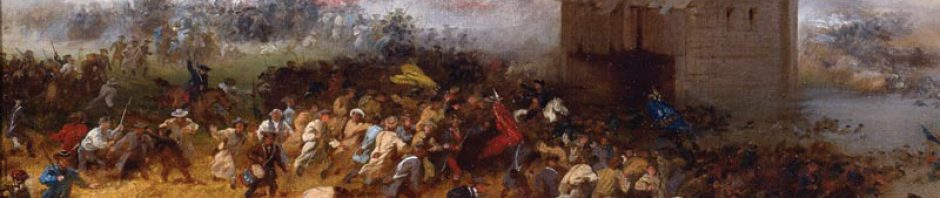
After the British landed on Long Island they advanced to within three miles of the American lines, and then they stopped. On August 23, 1776, the tension grew in New York as the American leadership tried to determine the enemy’s next move. The standoff that began on August 22 reinforced the Americans’ belief that the British were using Long Island as a diversion, and the main attack would come to Manhattan. General William Heath of Massachusetts captured the Americans’ uneasiness on the 23rd when he wrote to Washington, “I hope soon to hear good news from Long Island. I have never been afraid of the force of the enemy: I am more [afraid] of their arts. They must be well watched.”
Project sponsored by the Maryland Society of the Sons of the American Revolution

Recent posts: Finding the Maryland 400
Help Support the Maryland 400!
In August 1776, a group of soldiers—the Maryland 400—helped hold back the British Army at the Battle of Brooklyn, allowing the rest of the Americans to escape the field. The Marylanders lost a quarter of their men that day, but their stand saved the Continental Army, allowing it to live and fight another day. For […]
Revolutionary Book Review: George the Drummer Boy

The first book I ever read about the American Revolution was a children’s book called George the Drummer Boy, by Nathaniel Benchley, with illustrations by Don Bolognese. It tells the story of a drummer in the British Army who is stationed in Boston in 1775. His unit is chosen to march out of Boston to […]
A New Podcast Tells the Story of the Maryland Line
We are excited to share that a new podcast about the Revolutionary War, and Maryland’s soldiers, has been launched by Mission History. The series tells the story of the events that brought two armies, including nearly 2,000 soldiers from Maryland, to Camden, South Carolina in August 1781. The battle fought at Camden was one of […]
A Beating in Baltimore: Communal Violence during the Revolution
Today’s post comes from Marshall Cooperman of St. John’s College in Annapolis, who was part of the Maryland State Archives’ intern class of 2023. Marshall’s project team worked on cataloging a large collection of Revolutionary-era correspondence, and he came across the letters that tell this story while doing that work America in 1776 was a […]

 Finding the Maryland 400